[Update: Following a federal court order, the USDA has announced it will issue partial SNAP benefits for the month of November.]
The U.S. Department of Agriculture (USDA) recently announced that the agency will not provide federal food aid starting November 1st, causing a halt in SNAP benefits until further notice.
SNAP, or the Supplemental Nutrition Assistance Program, serves more than 40 million people across the country. In North Carolina, the crucial federal program helps more than 1.4 million North Carolinians put food on the table.
The Trump administration refused to use the funds from a $5 billion contingency fund to keep the program afloat in November.
Senate and House Republicans are also blaming Democrats for the second-longest government shutdown that started on October 1st. However, the shutdown is due to the refusal of Republicans to extend expiring subsidies under the Affordable Care Act. To add fuel to the fire, North Carolina still does not have a comprehensive state budget, as state Republicans chose to prioritize passing a politically corrupt redrawing of the state’s congressional maps.
“In addition to not caring about our people’s food security and their health care, they don’t care about people’s right to fair representation, and so they’ve decided to redraw the maps in the eastern part of the state to get another Republican seat and erase more than 30 years of representation from northeastern North Carolina and predominantly African American rural areas,” said NC Democratic Congresswoman Deborah Ross.
According to The Food Bank of Central & Eastern North Carolina, more than 1.6 million North Carolinians are food insecure; this statistic includes more than 500,000 kids. Now, with the government shutdown and the end of federal food aid, advocates and Democrats are raising concerns over where millions of people who rely on the food assistance program will turn to for food.
“This data confirms what we’ve long heard from people facing food insecurity in North Carolina: the loss of federal and state support couldn’t come at a worse time. The Food Bank Network has seen a sharp increase in demand for emergency food assistance over the past year — and that’s a direct result of the rising cost of living and cuts to critical support programs,” said Amy Beros, President & CEO of the Food Bank of Central & Eastern North Carolina.
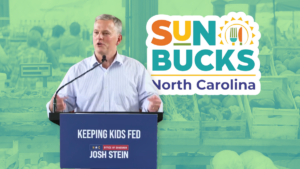
In response to the U.S. Department of Agriculture delaying November SNAP benefits due to the ongoing federal shutdown, North Carolina Governor Josh Stein is calling for the USDA to take action to prevent millions of Americans, and over 1.4 million North Carolinians, from going hungry.
“I am urging the USDA to take immediate action to prevent more than 1.4 million North Carolinians – including children, people with disabilities, veterans, and working families – from going hungry,” said Governor Josh Stein in a press release. “Specifically, USDA can deploy federal contingency funds and prevent a disruption of SNAP benefits on November 1. The administration’s refusal to use these available funds as temperatures cool and the Thanksgiving holiday approaches is a cruel abdication of the responsibility to support families and communities.”
Gov. Stein added, “Congress owes it to the American people to return to the negotiating table and come together to reopen the government, stop health care premiums from skyrocketing, and ensure stability for hardworking people across our state and country.”
Along with Governor Stein’s calls to the USDA to take action, North Carolina Attorney General Jeff Jackson is joining other Democratic officials across the country to sue the USDA, accusing the agency of illegally withholding more than $230 million in monthly food assistance for 1.4 million North Carolinians.
“Nearly 600,000 children in our state could be without food in a few days because USDA is playing an illegal game of shutdown politics,” AG Jackson said in a released statement. “They have emergency money to help feed children during this shutdown, and they’re refusing to spend it. I warned them last week that I would take them to court if they tried to hurt our kids, and today that’s what we’re doing”.
As food assistance demand is high and supplies are limited, community and peer-to-peer support are very important as we navigate these difficult times. We need to not only support food banks as much as we can, but also support each other.
Below are resources to access and donate food:
- NC211 Emergency Food Access and Basic Needs: Map for all of NC, search by zip code.
- Food Bank of the Albemarle (Northeast NC)
- Second Harvest Food Bank of Southeast NC (Fayetteville and Southeast NC)
- Food Bank of Central & Eastern North Carolina (Greater Triangle Region through Coastal NC)
- Inter-Faith Food Shuttle (Greater Triangle Region)
- Second Harvest Food Bank of Metrolina (Greater Charlotte area)
- Second Harvest Food Bank of Northwest NC (Greater Triad area and Northwest)
- MANNA Food Bank (Western NC)
- NC 211 – Dial 2-1-1 or visit nc211.org to connect with local food pantries, meal programs, and other essential services. Available 24/7 and in multiple languages.
To help, donate to your local food bank and have conversations with your friends, family, and neighbors about what they need most.
Here’s how to donate:
- Donate to the Food Bank of the Albemarle (Northeast NC)
- Donate to the Second Harvest Food Bank of Southeast NC (Fayetteville and Southeast NC)
- Donate to the Food Bank of Central & Eastern North Carolina (Greater Triangle Region through Coastal NC)
- Donate to the Inter-Faith Food Shuttle (Greater Triangle Region)
- Donate to the Second Harvest Food Bank of Metrolina (Greater Charlotte area)
- Donate to the Second Harvest Food Bank of Northwest NC (Greater Triad area and Northwest)
- Donate to the MANNA Food Bank (Western NC)
- Donate to NC 211 / United Way NC
In addition, NCDHHS is providing the following guidance for North Carolinians who depend on food and nutrition benefits:
- Continue to Apply and Renew: All residents should continue to apply for SNAP benefits and submit renewal paperwork on time. County DSS offices remain open and are processing all applications to prevent a backlog when funding is restored.
- Check Your Balance: Any benefits currently on your EBT card are still available to use. Check your balance on the ebtEDGE app, at ebtEDGE.com, or by calling the number on the back of your card (1-888-622-7328).
- If you or your family is in immediate need of food resources, please call 2-1-1 to be connected with local resources.
You can also visit the NCDHHS website dedicated to food access to find a food pantry closest to you.