
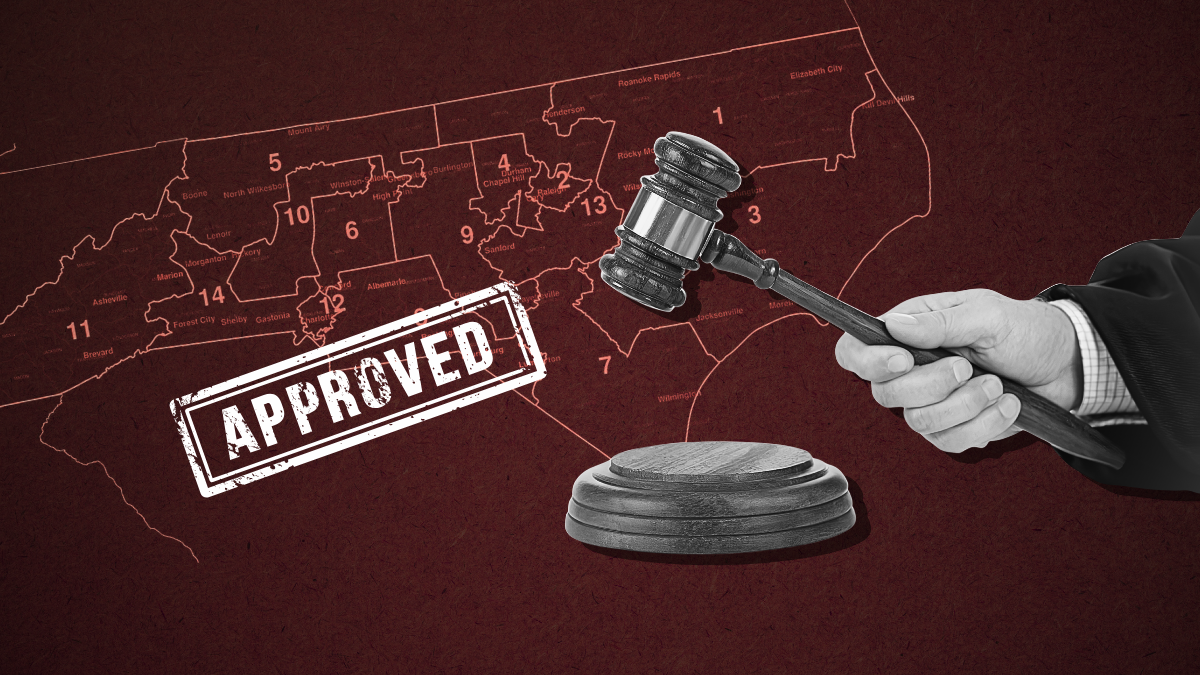
A federal three-judge panel recently cleared North Carolina to move forward with a newly revised congressional map designed to shift a key seat to Republicans as part of Donald Trump’s broader multi-state redistricting push ahead of the 2026 elections.
The updated map targets the state’s lone competitive district, currently represented by Democrat Don Davis, whose district covers more than 20 counties in northeastern North Carolina. The district has elected Black members of Congress for more than three decades.
After hearing arguments in Winston-Salem in mid-November, the panel declined to grant preliminary injunctions that would have halted the map’s use. One day later, the same judges separately upheld several other congressional districts redrawn by GOP legislators in 2023. Those districts were used in the 2024 elections and helped Republicans secure three additional U.S. House seats.
North Carolina is one of several states where Trump has departed from more than a century of political tradition by urging mid-decade redistricting without any court mandate. His goal is to help Republicans maintain control of the U.S. House during next year’s midterms, where Democrats need to gain only three seats to retake the majority and challenge his agenda.
Alongside North Carolina, Republican-led legislatures or commissions in Texas, Missouri, and Ohio have also approved new maps intended to strengthen GOP prospects in 2026. In contrast, California voters adopted new Democratic-leaning districts, and Virginia’s Democratic-controlled General Assembly has advanced a constitutional amendment that could lead to redistricting.
While lower courts have pushed back against several Trump-backed redistricting plans, many of those rulings have been paused by the U.S. Supreme Court’s conservative majority. That includes a recent Texas case in which a newly drawn map is projected to give Republicans five additional U.S. House seats.
North Carolina’s General Assembly, which is controlled by Republicans, gave final approval to the most recent map changes in October. The revisions could help the GOP maintain a narrow majority in the U.S. House. Democratic Governor Josh Stein’s signature was not required.
In a statement, Republican Senate leader Phil Berger said the decision “thwarts the radical left’s latest attempt to circumvent the will of the people,” noting that the state supported Trump in the 2016, 2020, and 2024 presidential elections. He added that, while Democratic-led states such as California move to counter Trump’s agenda, North Carolina Republicans are working to advance the “America First” platform.
The ruling addresses two lawsuits. In one, brought by the state NAACP, Common Cause, and several voters, plaintiffs argued that the legislature violated the First Amendment by specifically targeting the state’s “Black Belt” communities instead of Democratic-voting areas with higher white populations.
“Let’s be clear: This new map is part of a years-long strategy to entrench partisan control at the expense of Black voters in historically influential communities, silencing them based on viewpoint,” said Jaclyn Maffetore, Senior Staff Attorney at the ACLU-NC, in the group’s statement. “No one’s vote should count less because of who they are or what they believe.”
A second lawsuit filed by voters asserted that using census data from five years ago — required to complete a mid-decade redraw — violates constitutional standards, including the 14th Amendment’s one-person, one-vote requirement. The suit also claimed race was used improperly in the mapmaking process.
Republicans currently hold 10 of North Carolina’s 14 congressional seats due to the 2023 redistricting. They hope the latest adjustments to the First and neighboring Third districts will enable them to capture an eleventh seat, even though statewide elections remain closely contested.
Read more from The Guardian.