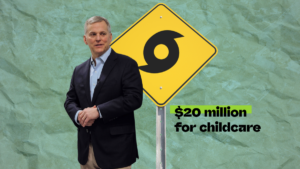

Standing in the nation’s capital more than a year after Hurricane Helene decimated Western North Carolina, Governor Josh Stein issued a sharp critique of the federal government’s financial commitment to the region, calling the current aid levels a drop in the bucket compared to historical disaster responses.
Gov. Stein, joined by a bipartisan group of local leaders, including Asheville Mayor Esther Manheimer and Republican State Senator Kevin Corbin, met with Congressional delegates and FEMA leadership last week to present a $13.5 billion request for funding.
The Governor’s message was rooted in a stark disparity: while the federal government has committed roughly $7 billion to North Carolina since the 2024 storm, that figure represents only 12% of the estimated $60 billion in total damages. By contrast, Stein noted that major disasters like Hurricanes Katrina and Sandy saw federal coverage closer to 70%.
“Disaster recovery is a team sport, and western North Carolinians can’t afford for the federal government to sit on the sidelines,” Stein said following the meetings. “It’s time for the people of western North Carolina to get their fair share.”
The Multi-Billion Dollar Gap
The proposed $13.5 billion package aims to bridge the funding gap by targeting critical infrastructure and housing. The request includes:
- $8.37 billion for Housing and Urban Development (HUD) to support homeowners in rebuilding.
- $1.77 billion for the Department of Transportation to continue repairs on the region’s treacherous mountain roads.
- $1.99 billion in forgivable FEMA loans to prevent local municipal budgets from collapsing under the weight of recovery costs.
Homeowners in ‘Limbo’
Beyond the broad funding requests, the Governor turned up the heat on FEMA regarding the Hazard Mitigation Grant Program (HMGP). More than 550 families in the mountains have applied for home buyouts—valued at $240 million—but many have been waiting months for a decision.
The delay has created a financial crisis for families who are currently paying mortgages on properties that were washed away or rendered uninhabitable.
While Stein did receive word during the visit that the first round of buyout applications had finally been approved, he pushed acting FEMA Administrator Karen Evans to clear the remaining backlog.
A Bipartisan Front
The visit highlighted a rare moment of unity between North Carolina’s Democratic executive and Republican legislative leaders. Senator Kevin Corbin emphasized that the recovery is an economic necessity for the entire state, not just the mountains.
The delegation also met with Congressman Chuck Edwards (NC-11), who has led the local effort to track the $2.9 billion already disbursed to survivors and infrastructure projects. Despite these existing funds, the ballooning costs of projects—like the nearly $2 billion estimate to fully restore I-40—have left officials across the political aisle agreeing that the initial federal response was only a down payment on a much longer, more expensive road to recovery.