
This story was originally published on The Front Porch by Down Home North Carolina
On The Porch With Nancy Beth Weaver
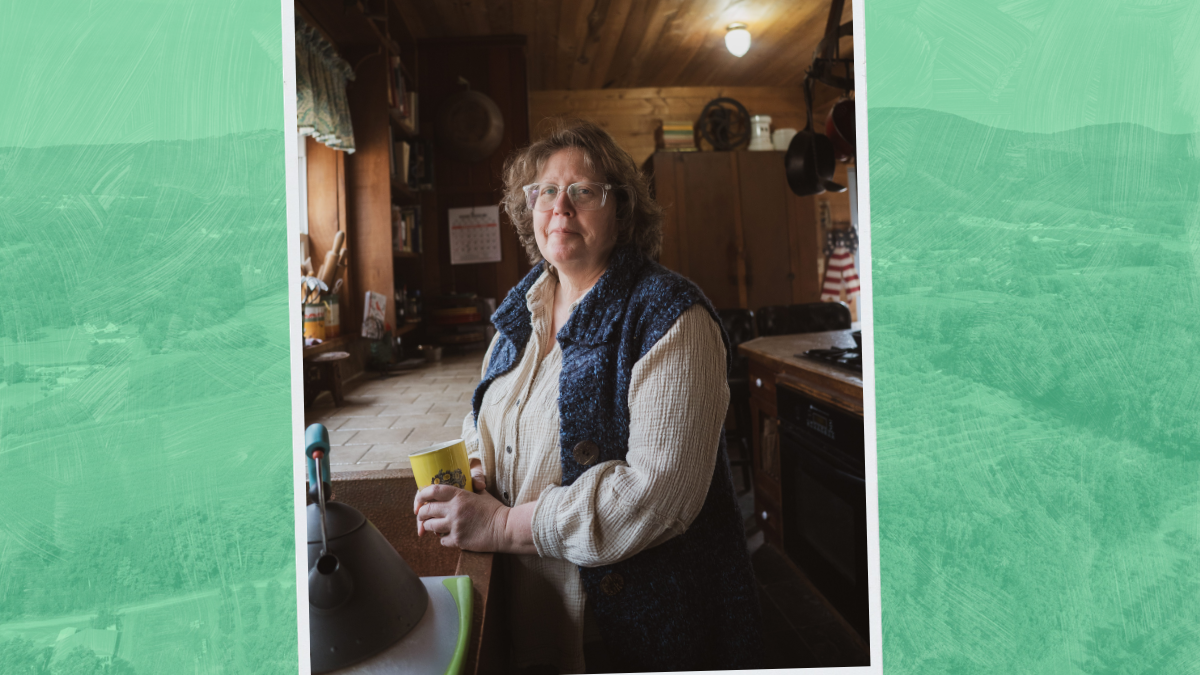
Nancy Beth Weaver, member of Down Home North Carolina, lives in a farmhouse she and her husband built, paycheck to paycheck, on land that used to belong to her grandparents. She has spent her life caring for the land, for animals, and for family in the North Carolina mountains — work that shaped how she made decisions about income, health, and risk. She is the seventh generation of her family to be born and raised in West Jefferson, near the intersection point for North Carolina, Tennessee and Virginia. She left after high school, but she couldn’t live without the Blue Ridge Mountains.
“They just draw you back. I have a connection. I raised five kids here and my eight grandkids are in and out of here at will. I hope that they can have the same love for the land that I do,” she said.
Weaver’s life is tethered to the land. It has served as a pasture for her cow, Penelope, and was an anchor for the sheep she raised for wool. As someone who weaves on a loom, she used the sheep’s wool for fiber. Weaving was, at one point, her main source of income.
And that income placed her in a gap. It wasn’t enough to qualify for health insurance on the Affordable Care Act marketplace. At that time in North Carolina, she didn’t have another option.
So when her legs gave out one day in the pasture while walking Penelope, she didn’t think to seek medical help. When she was upended by Blossom, a sow trying to get to a bucket of feed Weaver was holding, she resisted treatment for the concussion she knew she had sustained. And when her chronic thyroid disease flared up, she asked friends for their outdated prescriptions. Like many rural people without insurance, Weaver learned how to manage risk instead of health, weighing every ache or injury against what it might cost her to seek care.
“I was guessing and taking,” she said, of the medications she would receive from friends.
The birth of a grandchild changed things. In the weeks after the baby arrived, Weaver’s daughter needed help caring for her infant, especially while nursing at work. Seeing that need, Weaver’s boss stepped in — turning a vacant office into a nursery and hiring Weaver to care for the baby for $15 an hour. In a small town like West Jefferson, that kind of looking out for one another can make all the difference.
That salary, paired with an Affordable Care Act subsidy, made it possible for Weaver to finally carry health insurance without risking the farm. Based on her income, she received a subsidy that kept her monthly premium around $140 a month.
Health insurance changed Nancy Beth Weaver’s life. It also changed how she planned, allowing her to seek care early, manage chronic illness, and avoid the kind of medical debt that forces many rural families to sell land or leave home. It meant she could go to the doctor after a bite from a brown recluse spider that led to cellulitis. It meant she could see a specialist to manage her chronic thyroid disease. And it meant she could seek therapy to sort through emotional trauma.
With ACA insurance, she could seek care when she needed it, and not just when she thought she could afford it.
“I could just go to the doctor and they’d give me an antibiotic, instead of me trying various salves and potions,” she said, referring to her spider bite. “That’s a brain changer. It really is. I wouldn’t go to the doctor because I couldn’t afford it and I didn’t want to lose the farm,” she said. “I’m not scared of dying, but I’m scared to death of big hospital bills.”
For Weaver, the risk wasn’t medical care itself, it was what unaffordable bills could do to her ability to stay on the land she depended on. Weaver had gone for more than a decade without health insurance, losing coverage when her husband passed away in 2008.
“For the first time since 2008, I had insurance,” Weaver said. “It has made my life completely different. It’s been a gift.”
She has managed her chronic thyroid condition with regular doctors visits and taking medication that was prescribed to her. And, she’s received three years of therapy. It also allowed her to let go of feeling like she was a burden on her kids, who would constantly try to figure out how to get her covered or get her the immediate medical care she needed.
But, in 2026 she lost it. Her therapist was going to lose insurance, too, as subsidies for the Affordable Care Act haven’t been renewed. Without the subsidy, Weaver feared her monthly premium would jump to about $1,700 a month. And although she is in a better financial position now than she was when she became eligible for coverage a few years ago, she doesn’t make enough to cover that jump.
Ultimately, she found a policy that more than doubled her premium, included a high deductible, and excluded the specialists she needed to see to manage her chronic illness from coverage.
Without the subsidy, the higher cost is forcing her back into the same calculations she lived with for years; deciding which care she could delay and which risks she could afford to take.
Weaver will have to adjust to make ends meet. She now knows where to get bloodwork at a fraction of the price and her endocrinologist offers virtual appointments, which are less expensive than office visits. If it comes to it, she knows she can seek care at the health clinic nearby that has to treat everyone regardless of their ability to pay. It’ll be busy, but she knows it’s a resource.
Weaver doesn’t describe these adjustments as ideal — just necessary in a system where affordable coverage can disappear even when the need for care does not.
“I’m fortunate that I have a place to live and a car to drive. Really and truly, I’m at a place in life where I’m okay,” Weaver said, feeling lucky to have found a nurse practitioner who was also once uninsured.
“She gets it. She’s really good.”
This story is part of Down Home North Carolina’s The Front Porch. The Front Porch is a publication that shares the stories of the many voices, faces, and communities of rural North Carolina.
If you are interested in reading more stories of rural North Carolina, subscribe to The Front Porch substack here: The Front Porch
To view more stories, check out: