Source: NC Newsline
In the past few weeks, school districts across the state have struggled to implement provisions included in Senate Bill 49, also known as North Carolina’s version of Florida’s “Don’t Say Gay” bill.
The controversial proposal became law back in August, and erases lessons about gender identity, and sexual orientation, and threatens educators with disciplinary action if they refuse to out students to their parents.
Under the updated version of the state budget, schools have until January to incorporate the discriminatory measures into their policies. However, the task has been challenging for many, including Chatham County Schools.
“This is probably the most sweeping piece of legislation I’ve seen in terms of just trying to understand its depth and breadth over time,” Superintendent Anthony Jackson told the Chatham County Board of Education earlier this month.
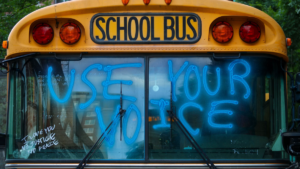
According to N.C. Newsline, Senate Bill 49 comes at a time when school districts like Chatham County are struggling to fill bus drivers, math, and special education teacher vacancies.
Instead of addressing these needs in the first few weeks of the school year, school districts had to spend time implementing the controversial law.
Chatham County is not alone in stalling its implementation, Buncombe County, Wake County, and many other school districts are having challenges.
“We’re now talking about how we might be able to provide additional resources to hire teachers, to incentivize hiring teachers, to get more math teachers, this [SB 49] is what our instructional people have had to spend their time on — not getting our new teachers prepared to teach mathematics, not getting our new teachers prepared to plan good lessons,” Jackson added.
For Chatham County parents, the passage of the law draws in concerns surrounding the ability to attract new teachers and retain those already in the district.
“At a time when it is so hard to attract new professionals into education fields and retain the talented teachers we currently have, I ask that you do everything you can to ensure that educators know that they are safe, protected and valued within our district,” Julie Ricker, a local parent, told NC Newsline.
Similar to other school districts across the state, right-wing organizations have set up shop in Chatham County. Moms for Liberty, a national right-wing organization that pushes forth challenges against Black, Brown and LGBTQ+ focused books, classroom discussions on topics such as race, gender, and sexuality, and supporting extremist candidates, launched a local chapter in 2022.
Since then, the school district has faced book ban challenges from the right-wing’s local chapter, and accusations of educators focusing on diversity, equity and inclusion at the expense of reading and math instruction, according to N.C. Newsline.
“The vast majority of Chatham County parents know that clogging up the system with demands to inspect materials and requests to ban books will not help us attract and retain top-notch educators,” Emily Martine, a Chatham County parent, told NC Newsline. “Unfortunately, there is a vocal, extremist minority in this county that is backed by a strong national organization. We don’t need people from surrounding counties or Florida or Texas flooding our district with complaints.”