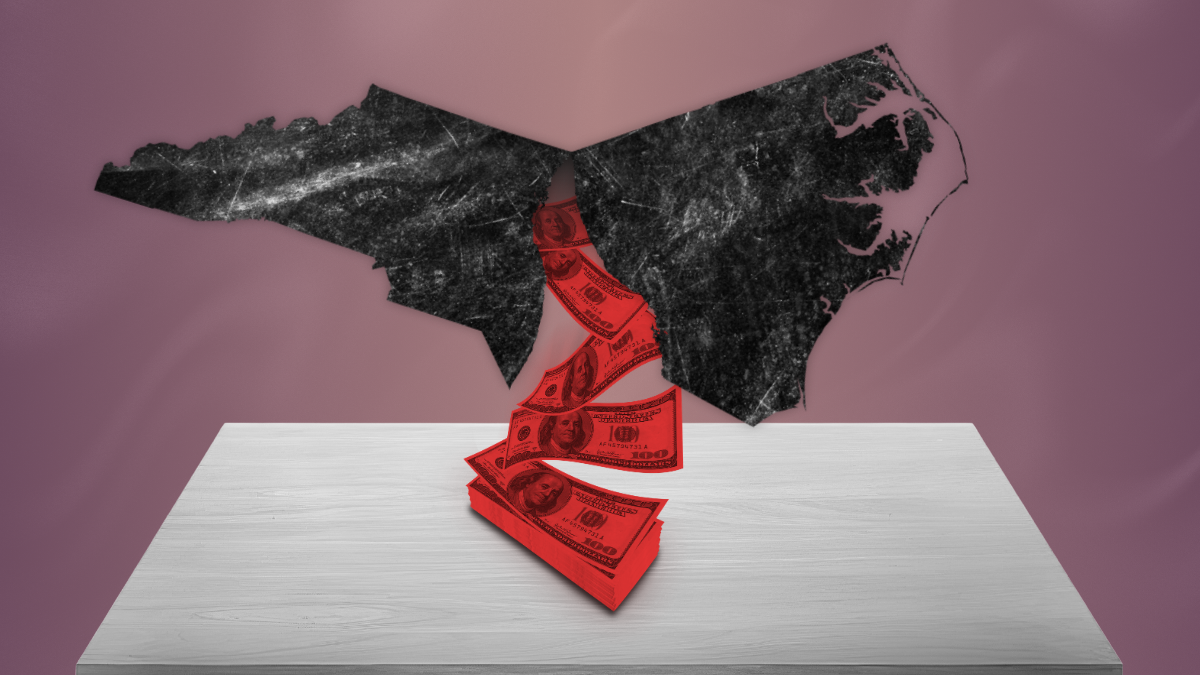
Two proposed amendments to the North Carolina Constitution could significantly change how state and local governments collect tax revenue, according to an analyst with the NC Budget and Tax Center.
North Carolina voters will decide on the amendments in November. One would establish a constitutional cap on individual and corporate income tax rates, while the other would require the state Legislature to limit increases in property taxes.
Income Tax Cap Could Lock In Future Tax Rates
One proposed amendment would cap individual and corporate income tax rates at 3.5%.
Sally Hodges-Copple, a senior public policy analyst with the nonpartisan NC Budget and Tax Center, told Cardinal & Pine that the amendment would largely lock into the state Constitution tax cuts that have been enacted over the past 13 years, particularly those affecting corporations and higher-income households.
North Carolina’s individual income tax rate is currently 3.99%, but state law already calls for it to fall to 3.49% in 2027. The corporate income tax rate is currently 2% and is scheduled to be eliminated by 2030.
Because the 3.5% limit would be written into the Constitution, changing the rate above that level would be considerably more difficult, Hodges-Copple said.
She also said limiting income tax revenue could shift more of the cost of government services onto fees and other taxes.
“The costs don’t go away. They just get shifted onto local government and onto families and individuals,” she said.
The amendment was referred to voters in votes that divided largely along party lines, with Republicans supporting the measure and Democrats opposing it.
Republicans have argued that the amendment would protect taxpayers from future tax increases. Democratic Governor Josh Stein has disputed that characterization, noting that tax rates are already scheduled to decline under current law.
During a news conference last month, Gov. Stein said at a news conference that the amendment would not put additional money in people’s pockets because the tax reductions are already scheduled to occur. He argued instead that limiting future income tax increases could leave state lawmakers with fewer options for raising revenue when additional funding is needed.
Property Tax Amendment Would Shift Authority to Raleigh
The second proposed amendment would require the Legislature to establish limits on how much property taxes can increase, shifting authority over property-tax growth away from local governments and to state lawmakers.
The change could be significant for counties such as Buncombe, where property taxes account for about 66% of local government revenue used to provide services, according to the NC Budget and Tax Center.
Those services include public libraries, law enforcement, education and emergency response. In Buncombe County, about 32% of the cost of operating public schools comes from local funds, according to the center’s report.
The property tax amendment also received support from Republicans and opposition from Democrats in both chambers of the General Assembly.
A report from the North Carolina Housing Coalition examined the potential impact of a hypothetical 2% limit on property-tax increases. Under that scenario, the average North Carolina homeowner would save about $84 per year in property taxes, while local governments collectively would lose an estimated $950 million in property tax revenue.
Hodges-Copple said that amount would be substantial enough to have a significant impact on public services and local government budgets.
“That would be enough revenue to bring every paid fire protection worker in North Carolina up to a living wage. It would be enough to fund annual salaries of almost 16,000 police officers,” she said.
If local governments were unable to increase property tax revenue as needed, residents could ultimately see some combination of reduced services and increased fees, Hodges-Copple said.
The amendment also does not specify the exact property tax limit that would apply. That limit would have to be established by the Legislature.
As a result, state lawmakers in Raleigh—not locally elected officials—would ultimately determine how much property tax revenue counties such as Buncombe could collect to address needs including housing, disaster recovery, public education and emergency services.
“It would not be local elected leaders making that decision about revenue,” Hodges-Copple said.