
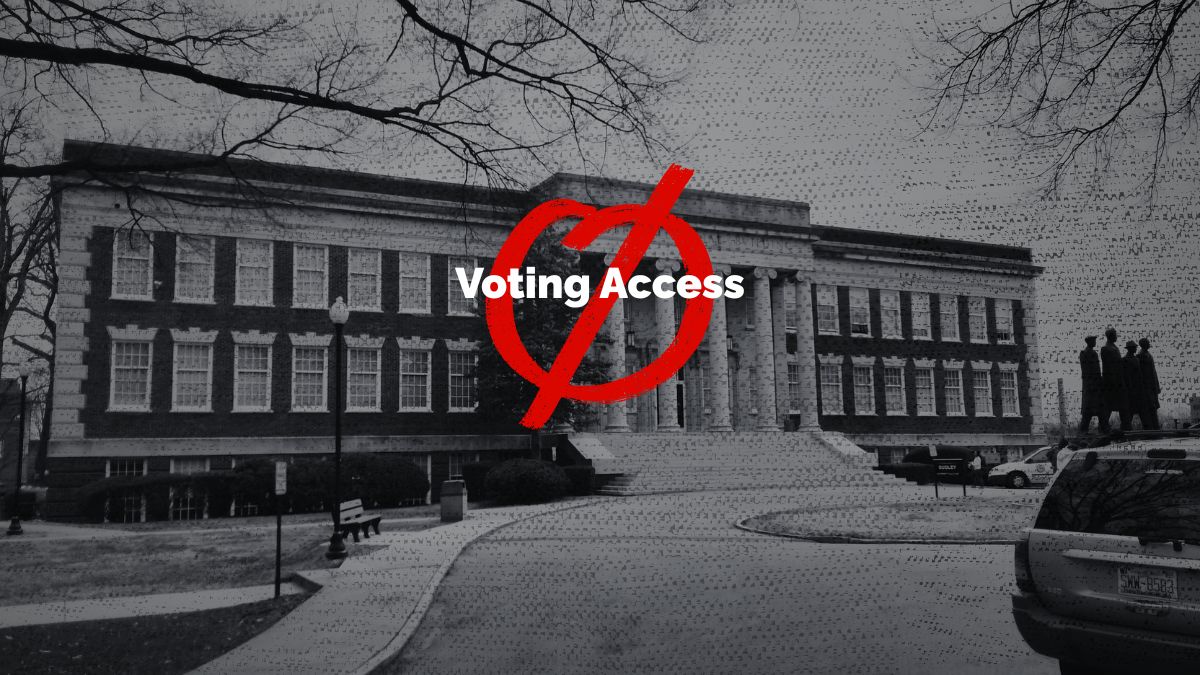
After State Auditor Dave Boliek switched every county board of elections to a Republican majority, some of those county boards are now suggesting rolling back voting sites near and on North Carolina college campuses. Once the Republican-led General assembly gave Boliek new and unique powers over the North Carolina State Board of Elections (NCSBE), one of his first moves was to change the makeup of the state board– flipping it from a Democrat majority to a Republican majority. Soon after that the county boards followed and Boliek had manipulated all 100 North Carolina county boards into a Republican majority.
With the candidate filing period for the 2026 primary election coming to a close, these boards are holding meetings and votes to decide how the upcoming elections will be conducted. Anything that cannot be decided by the county boards will be determined by the NCSBE. With these discussions underway, voters in some counties are facing reduced access to voting as these Republican majorities stand in opposition to new voting sites and even push for some to be removed.
Guilford County
In Guilford County Republicans opposed Democratic board member Carolyn Bunker’s attempt to add early voting sites for the midterms to two university campuses: North Carolina Agricultural & Technical State University (NCA&T) and the University of North Carolina at Greensboro (UNCG. Though these sites have been used during presidential election years, they have not been used during midterm elections.
After her first proposal was rejected, Bunker suggested two other locations, one at Barber Park and another at Washington Terrace, in areas with lower economic standing. This proposal was also rejected by the Republican majority. “The bottom line is, I think that they are trying to disenfranchise a certain part of the population — two parts of the population, the poor and the students,” Bunker said.
The chair of the board, Republican Eugene Lester III, started that meeting by talking about the privilege of voting. “Voting is a privilege,” he said. “Voting requires the citizens to actually take some action, to do some things, to discharge a duty, and it may require some work on the citizens’ parts.”
Jackson County
Meanwhile in Jackson County, Republicans voted to remove an early voting site on the campus Western Carolina University, claiming it was not an accessible voting location and was not as welcoming to the broader community. College campuses often hold events for the community at large and this specific site has helped significantly increase the turnout of younger voters in the county since its establishment in 2016, with 76,000 votes cast at the early voting site over nine elections.
Cumberland County
Cumberland County Board of Elections decided not to use their office as an early voting site, leading to a need for a new location. The Republican majority chose a location that had been used in the past: Kiwanis Recreation Center. However, Irene Grimes, a Democrat on the board, suggested the Smith Recreation Center, which is located across the street from Fayetteville State University.
Though both the majority and minority on the board agree on the location across from Fayetteville State University the board is split on action for another site. Republicans want to add Kiwanis Recreation Center, while Democrats want to exclude it citing that it’s in one of the wealthiest neighborhoods in the county. Instead Democrats proposed a polling site around Spring Lake. With no final decision from the board, the NCSBE will be weighing in.
North Carolinians Overwhelmingly Support Polling Sites For College Campuses
Some in the political sphere may equate having polling sites at college campuses to aiding Democratic voters. However, a poll from Common Cause North Carolina found that 78% of North Carolina voters support polling sites that serve college students. Hosting voter registration drives, early voting and polling locations at college campuses in North Carolina increases voter turnout as well as voter registration among college students, both Democrats and Republicans alike.
Zach Powell, president of the Western Carolina University’s College Democrats, said the false idea of university polling sites only helping Democrats may have negatively influenced the board members who voted to remove the polling site from his school. “I definitely think that some of them, probably they have preconceived notions about college students and the way that they vote that aren’t necessarily reflective of the reality in Jackson County, on WCU’s campus, because Republicans and Democrat students use the polling site at roughly the same rate,” Powell said.
Powell argued students deserve more consideration when elected officials discuss these plans. “They live there, they learn there, they work there,” he said. “In a lot of cases, they contribute to the local economy. They’re there for more than half of the year, and there are decisions made at the state, local and federal level that affect college students.”