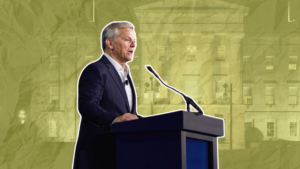
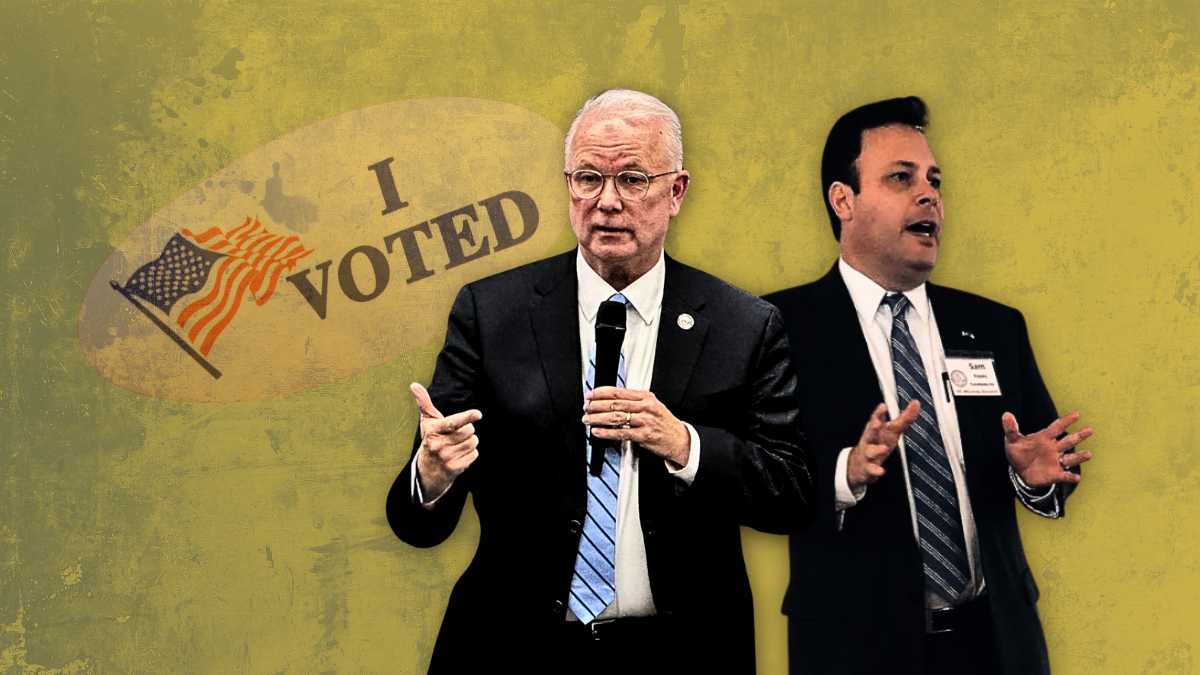
When Dave Boliek won the 2024 general election for the North Carolina State Auditor and became the first Republican to hold the office in 16 years, he claimed he wanted to leave party politics out of his work. “I’m going to leave the party politics at the door when it comes to the job of the state auditor,” Boliek said. “That doesn’t mean I’m going to leave conservative principles at the door. That doesn’t mean I’m going to leave my moral compass at the door.”
Yet, since he has assumed office, his position has been highly politicized, the target of partisan shifts in power, and often found at the center of party politics. The most recent show of Boliek’s partisanship is the auditor campaigning for Senate Leader Phil Berger at an early voting site as Berger faces a tight primary fight against Rockingham County sheriff Sam Page. This raised concerns as Boliek is also overseeing the North Carolina State Board of Elections (NCSBE), the only Auditor in the country to have that power– and he has Berger to thank for that.
After Democrats won many of the council of state positions in the 2024 general election, Berger and other Republicans drafted a bill to give Boliek control over the North Carolina State Board of Elections while simultaneously stripping power away from incoming Democratic leaders like Josh Stein. The bill was fought in court but was eventually upheld and transferred powers that had resided with the governor for over a century to the auditor. Once Boliek gained that power, he manipulated the state board and all 100 county boards to have a 3-2 Republican majority.
Additionally, Berger sought to boost the auditor’s position even more by proposing a bill that would give even more oversight to the auditor’s office in what was labeled the D.A.V.E Act. Though the D.A.V.E Act did not pass both chambers, Berger and other Republican lawmakers have passed other legislation to increase the Auditor’s reach, with laws like House Bill 549, “Clarify Powers of State Auditor.”
Boliek insists he has done nothing wrong by campaigning with Berger. The sentiment was echoed by Elections director Sam Hayes, who attended a recent campaign fundraiser for U.S. Representative Tim Moore (R-N.C.). State law prevents election board members from donating to campaigns, fundraising for candidates, and making public statements opposing or supporting a candidate. However, individual expressions of opinion are allowed. Yet, these actions were still troubling, as in the past, the NCSBE board had avoided such shows of favoritism.
Senator Terence Everitt (D-Wake), Executive Director of the North Carolina Voter Protection Alliance, criticized Boliek’s and Hayes’ partisan support.
“Election administrators are supposed to be the referees,” Everett’s said in a statement. “When referees show up in campaign spaces, especially during active voting, it blurs lines that should be clear.”
The very real connection between Boliek, who is in charge of two historically non-partisan state agencies, and the veteran Republican lawmaker who has given Boliek so much power is a conflict of interest now center stage in one of the most-watched primary fights of 2026.
As of election night, Berger was losing his primary race against Rockingham County Sheriff Sam Page by just two votes, a margin that has since widened to twenty-three votes. As the last votes are being counted, Page is asking for Boliek to recuse himself, citing a conflict of interest.
“The optics just don’t look good,” Page said in an interview. “That doesn’t give me fair and objective optics.”
Page hasn’t received a response from Boliek but stated a recusal in this case would be “pretty obvious” considering the relationship between Boliek and Berger.
Though Boliek said he wanted to leave party politics at the door, he has proved during his time in office that it is not the reality of the Auditors’ office or the NCSBE under his watch, and the conflict of interest spells trouble for everyone.
“If the State Auditor intends to involve his office more directly in election oversight, that office must hold itself to the highest standard of independence,” Everitt insisted. “Oversight authority and visible partisan alignment cannot sit comfortably together.”