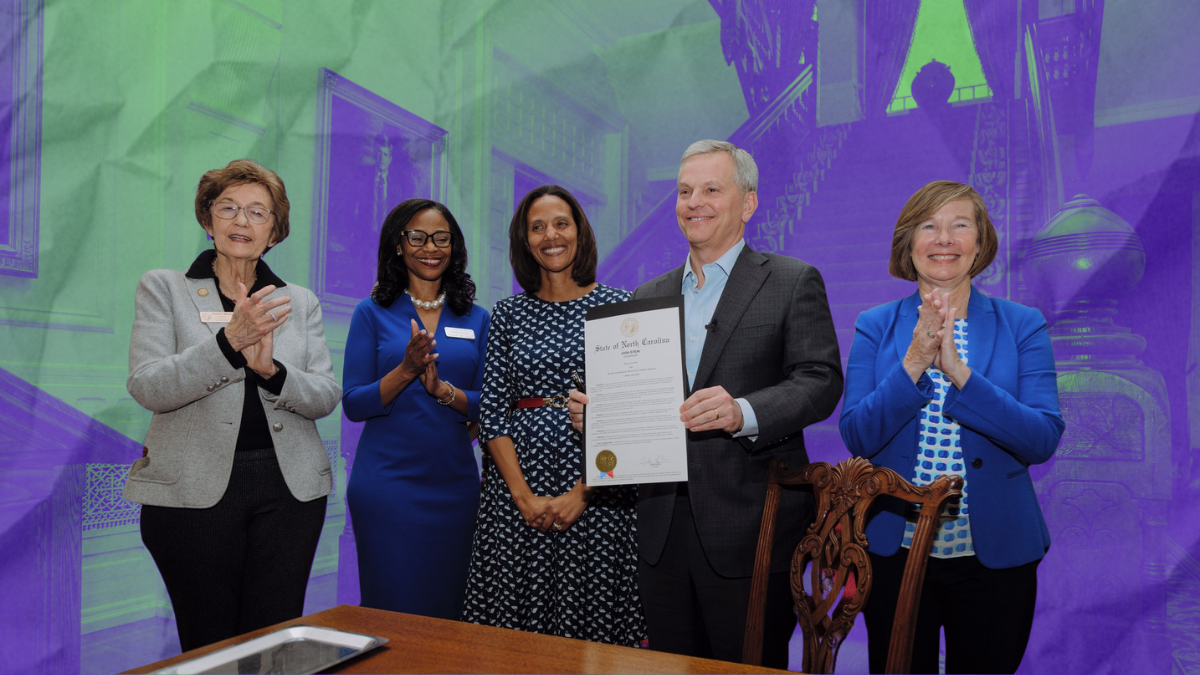
A new law recently signed by North Carolina Governor Josh Stein extends the length of parental leave for state and public school workers. Senate Bill 1041: Public Workforce Modernization Act, increases the number of days full-time employees are allowed parental leave from 8 days to 12. The bill passed both the House and the Senate with the full support of lawmakers.
“Now, any parent knows that juggling work and being a new parent is no small task,” Gov. Stein said at the bill signing, alongside teachers and state workers. “But with this state policy, we’re making it easier for parents to succeed in the state’s workforce.”
Anna Troxler, a public school teacher who attended the bill signing, told the crowd that when she had her first child, she did not receive paid parental leave. She explained that it resulted in a financial burden when she had to take a leave of absence for her health. With her second child, she received 8 paid weeks of leave, a relief in comparison.
“It’s so important for teachers to be able to take care of themselves in order to take care of their students,” Troxler said. “And this bill provides the support needed for teachers to do so.”
The 12-week parental leave is extended to all parents. Previously, only birthing parents received the full time of 8 weeks. Non-birthing parents received half that, at just 4 weeks. Tina Sherman of MomsRising emphasized the importance of extending the benefits of parental leave to both parents.
“Studies have shown that when both parents are engaged, have access to that leave, it benefits the entire family,” Sherman said.
Only 14 states and the District of Columbia have “comprehensive, mandatory” state-paid parental leave, according to the Bipartisan Policy Center.
The bill also makes it easier to apply for state jobs, creates work-based learning opportunities for state employees, and helps spouses of servicemembers find jobs in state government, according to a press release from Stein’s office.
“With these updates, we remain on track to make North Carolina the best place to live, work, and raise a family,” Stein said.
The law goes into effect on October 1st.