This editorial was originally published on Cardinal & Pine.
After the expiration of Affordable Care Act tax credits and growing uncertainty surrounding Medicaid, more North Carolinians are finding themselves without coverage. For those who’ve lost health insurance, free clinics and providers offer help in uncertain times.
By: Dylan Rhoney
Roughly 220,000 fewer people in North Carolina enrolled in Affordable Care Act (ACA) insurance plans this year, a steep decline after the loss of federal subsidies that made plans more affordable.
As of 2024, more than 10% of the state population remained uninsured, according to US Census data. That number is likely to rise this year and next amid the loss of federal subsidies and looming federal cuts to Medicaid.
If you’re one of the North Carolinians who’ve lost coverage through the ACA, or are worried about losing coverage through your job, here are some resources to help you obtain care.
See if you qualify for Medicaid
The first stop for many uninsured is Medicaid, the public health insurance program that provides insurance to lower-income Americans. North Carolinians whose income does not exceed 138% of the federal poverty level are eligible for the program.
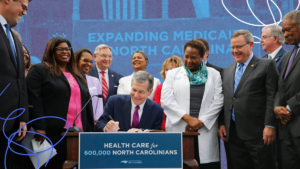
North Carolina’s expanded Medicaid program has provided coverage to over 700,000 people since it launched in 2023.
Medicaid expansion provided coverage for those whose incomes were too high to enroll in traditional Medicaid, while also not earning enough to afford monthly private insurance premiums. Beyond income requirements, you must be a US citizen or have legal status, be a resident of North Carolina, and have a Social Security number to be eligible for Medicaid.
You can learn more about whether you might qualify here and how to apply here.
Free clinics
For those who don’t qualify for Medicaid and can’t afford monthly premiums for private insurance, The North Carolina Association of Free and Charitable Clinics, a collection of 61 individual clinics, is another option. These clinics provide services for the uninsured, including primary care, comprehensive care, pharmaceutical needs, and dental care, though not all locations offer all of these services.
The organization provides healthcare to uninsured residents who earn 300% of the federal poverty line or less—$47,880 for an individual or $99,000 for a family of four.
“People that are living paycheck to paycheck, making $35,000 to 40,000 a year, with a family of two or three, there is no way they can afford healthcare. That’s who we serve,” April Cook, the organization’s Executive Director, told Cardinal & Pine. “We’re not just an urgent care dealing with acute issues. We deal with chronic disease… we do the same thing that a private practice does.”
You can search the list of all Free and Charitable Clinics in North Carolina here, along with the services each location provides.
Connecting the uninsured to providers
AccessHealth organizations are another option if you’re uninsured. These physician referral services connect uninsured individuals with health providers and hospitals in their communities. You can find a local program in your area here.
Cape Fear HealthNet, which serves southeastern North Carolina, is one of 18 AccessHealth organizations. It connects uninsured people in New Hanover, Brunswick, Columbus, and Pender counties to free and low-cost partnered clinics and Novant Health hospitals in the region.
Like the North Carolina Association of Free and Charitable Clinics, Cape Fear HealthNet offers help to patients earning up to 300% of the federal poverty level.
Dr. Andre Leonard, a Wilmington-based primary care doctor who serves as the organization’s Medical Director, says patients enrolled in their program receive care on par with private insurance.
“The services that we can provide are the same as what anybody who has private insurance can get. We offer specialists ranging from cardiology, neurosurgery, any orthopedics, any physician-related speciality care, but also ancillary services like physical therapy,” he told Cardinal & Pine.
Leslie Smiley, the Executive Director of Cape Fear HealthNet, estimates that around 300 primary care providers and specialists collaborate with the organization to serve the 800-900 patients enrolled in their program.
To enroll, prospective patients can reach out by phone at 910-399-2751 to set up an appointment.
“We can normally give a person an appointment within two or three days. They’ll meet with that eligibility specialist. They can do it by phone interview or come and meet in person. We do the application and notify them of what information we need to process their application, whether that’s their wages or verification of their residency,” Smiley said.
Once approved, a patient can begin reaching out to providers connected to Cape Fear HealthNet to make an appointment or seek care. The organization tries to process applications within a week, but has up to 30 days to do so.
Leonard said that the wait time from application to appointment is usually shorter for the program’s participants relative to people with private insurance.
Smiley says there is no limit to how long a patient can be enrolled in the program.
“We’ve had folks who have been part of this program since the beginning,” she said. “We do re-enrollment yearly to determine they’re still uninsured, still income eligible.”
Here is a list of all HealthAccess Networks in North Carolina:
| NETWORK | COUNTIES SERVED | MAIN PHONE NUMBER | WEBSITE |
| HealthNet Albemarle | Gates, Pasquotank, Perquimans, Currituck, Chowan, Camden, Dare | 252-248-3045 | Website |
| Burke Health Network | Burke | 828-334-6159 | Website |
| Cape Fear HealthNet | New Hanover, Brunswick, Columbus, Pender, | 910-399-2751 | Website |
| Care Ring/Physicians Reach Out | Mecklenburg | 704-375-0172 | Website |
| Carolina HealthNet | Chatham, Orange, Alamance, Caswell, Lee | 919-545-3440 | Website |
| Cumberland HealthNET | Cumberland | 910-483-6869 | Website |
| Greater Hickory Cooperative Christian Ministry | Catawba, Alexander | 828-327-0979 | Website |
| Guilford Community Care Network | Guilford | 336-895-4900 | Website |
| HealthCare Access | Forsyth, Yadkin, Davie, Stokes, Davidson | 336-723-6565 | |
| HealthCare Connection Wilkes | Wilkes | 336-651-7386 | Website |
| HealthNet Gaston | Gaston | 704-874-1958 | Website |
| Hertford Health Access & Roanoke Chowan Community Health Center | Hertford, Edgecombe | 252-209-0237 | Website |
| Project Access of Durham County | Durham | 919-213-4077 | Website |
| Project Access of Johnston & Harnett County | Johnston, Harnett | 919-550-0011 | Website |
| Project Access – Wake & Franklin Counties | Wake, Franklin | 919-819-6281 | |
| Care Connect of Rockingham County | Rockingham | 336-840-5686 | Website |
| The Free Clinics | Henderson, Polk | 828-697-8422 | |
| Western Carolina Medical Society – Project Access | Buncombe, Madison | 828-274-6989 | Website |
Pressure on organizations as more people become uninsured
Looking ahead, Cook says she worries about the organization’s capacity to meet the needs of a growing uninsured population given the expiration of the ACA tax credits, and the possibility the state’s Medicaid expansion program will be reversed due to President Trump’s ‘One Big Beautiful Bill,’ which is expected to cause upwards of $1 trillion in cuts to Medicaid over the next decade.
When the North Carolina General Assembly passed Medicaid expansion in 2023, it included a ‘trigger law’ as part of the bill, which would end the program if the federal government’s commitment fell below providing 90% of funding for Medicaid.
“Our fear is how are we going to take all these folks back on,” Cook said. “If those people on expanded Medicaid are uninsured again, and ACA subsidies have been eliminated, we may be looking at more folks than we had before expansion. We may double that amount of uninsured. And there’s no way [even] with all the safety net put together… [we] will not be able to handle the onslaught of uninsured in North Carolina,” she said.
Dylan Rhoney is an App State grad from Morganton who is passionate about travel, politics, history, and all things North Carolina. He lives in Raleigh.
Cardinal & Pine is owned and operated byCOURIER, a pro-democracy news network that is building a more informed, engaged, and representative America by reaching audiences where they are online with factual, values-driven news and analysis at the local and national level.