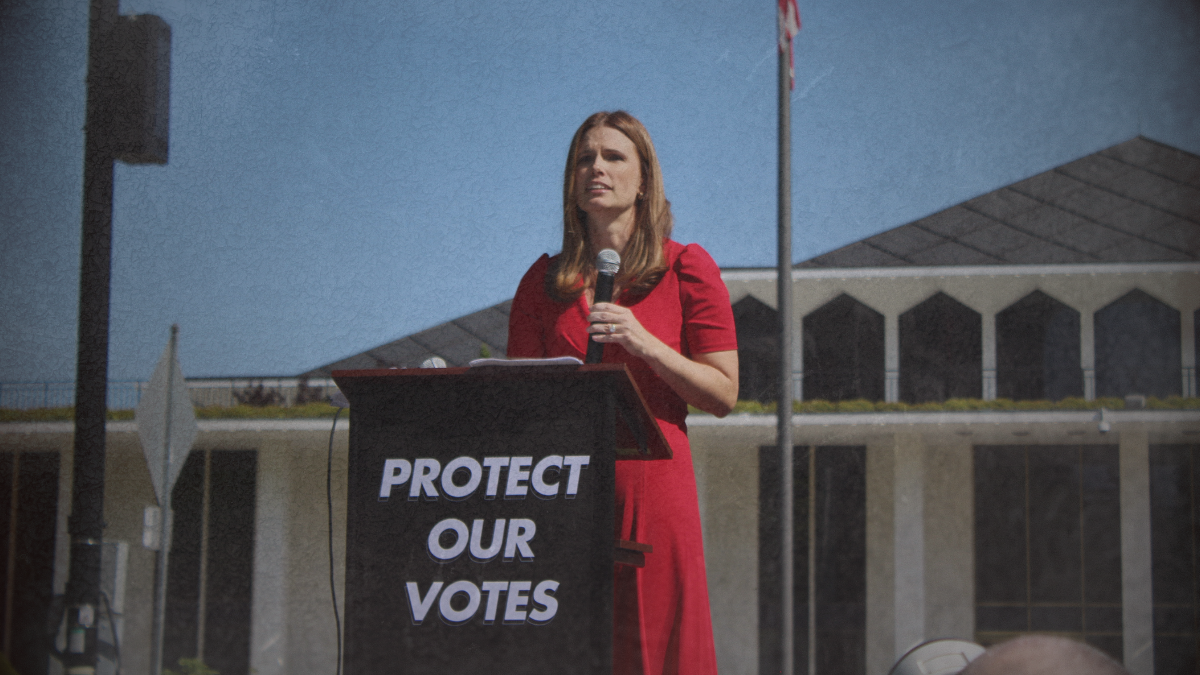
Last week, hundreds of voters gathered in downtown Raleigh to show support for North Carolina Supreme Court Justice Allison Riggs amid her opponent, state Court of Appeals Judge Jefferson Griffin’s challenge. The rally was held at the Bicentennial Plaza with advocates, impacted voters, and military servicemembers.
Justice Riggs defeated Judge Griffin by 734 votes in the 2024 November election, but in the five months since, the Republican judge has attempted to overturn the election results and asked courts to throw out more than 65,000 votes.
“I am standing here today as your Supreme Court justice, but also as a daughter, a sister, and a proud North Carolinian who is committed to standing up for our service members and their families, just like they stand up for us,” Justice Riggs told supporters last Monday.
“It is no more acceptable to only disenfranchise a few thousand people instead of 65,000 people.”
Justice Riggs was joined by state Sen. Val Applewhite and military veterans. Sen. Applewhite said it is unfair that those in the service and their families may have their votes thrown out.
“When you serve your country, you don’t ask for special treatment. You ask for fairness, you ask for respect, and above all, you expect for your vote to count,” Sen. Applewhite told the crowd. “They are trying to disenfranchise our active duty service members.”
Among the 65, 500 votes that are being challenged, Griffin asked courts to disqualify the votes of around 5,500 military servicemembers and overseas voters who voted in the same manner as he had. With recent decisions from the state Supreme Court, this number could change.
Justice Riggs has expressed her eagerness to fight and protect the thousands of voters whose ballots are being challenged.
“This ruling cannot stand and we will fight it tooth and nail,” Riggs said. “We’re going to fight as long as it takes to protect voters and the rule of law.”