
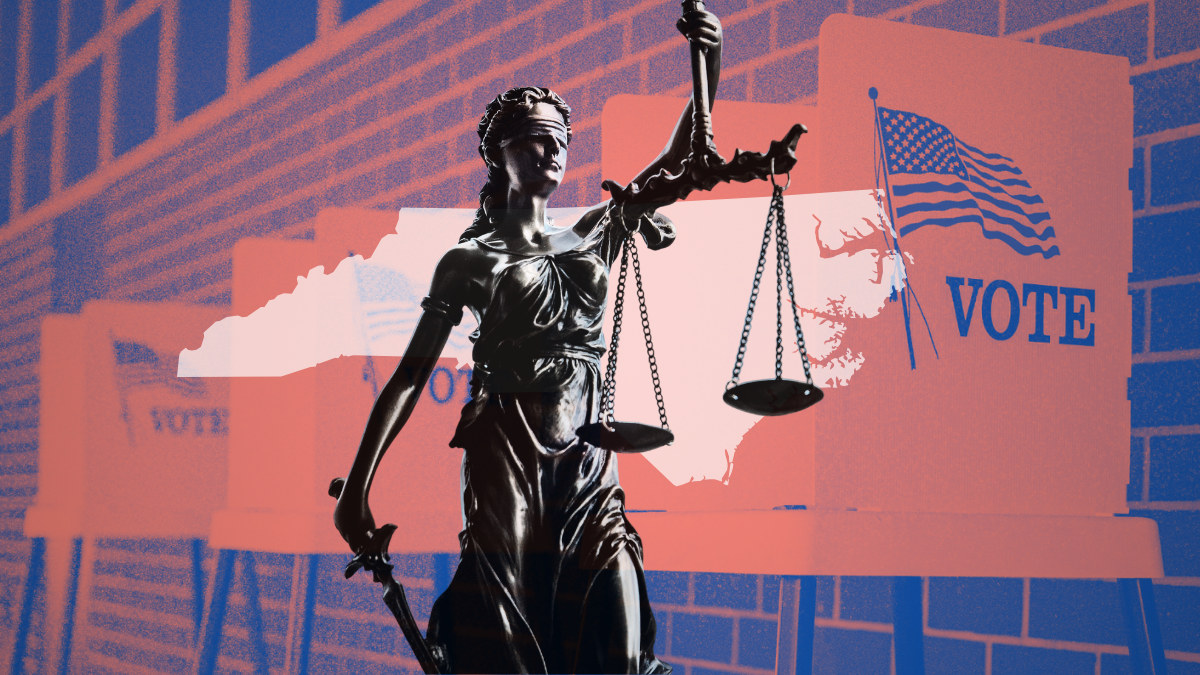
This year, over thirty states will hold elections for Supreme Court seats, including Texas, Montana, Wisconsin, and North Carolina. For North Carolina, the stakes are especially high for the upcoming judicial elections, as concerns around public confidence in the integrity and impartiality of the judiciary are ever-growing.
Advocates, legal experts, and voters have sounded the alarm over the growing partisanship of the state’s highest court, which flipped to a 5-2 Republican majority following the November 2022 elections.
Following the drastic shift on the bench, the newly Republican majority, led by Chief Justice Paul Newby, chose to undo several Supreme Court decisions, including on voter ID and gerrymandering, which were decided by the previous Democratic majority.
These rulings, especially on gerrymandering, were controversial for a majority of North Carolinians. According to a recent statewide poll from Common Cause NC, over 76% of North Carolina voters disagree with the Newby-led court’s ruling in this case and said partisan gerrymandering should be illegal.
In a ProPublica piece, former justices, judges, and Republicans stated that Newby acts more like a political operator than an independent jurist.
“Without question, Chief Justice Newby has emerged over the past 20 years as one of the most influential judicial officials,” stated Former North Carolina Supreme Court Justice Bob Orr. “The effect has been that the conservative legislative agenda has been virtually unchecked by the courts, allowing the sweeping implementation of conservative priorities.”
According to a recent blog from Carolina Forward, the growing partisanship led by Newby and his counterparts is all by design. Since the early 2000s, state Republicans, under the guise of a conservative strategist, have focused on winning the courts and passing legislation to stack the deck in their favor in upcoming elections.
The latest example – Harper v. Hall – shows how the Republican-majority court can create a political advantage for their fellow party members. Due to the high court’s ruling, the Republican-led legislature was able to redraw partisan gerrymandered maps to secure an additional seat for their party in the 2026 midterms, as requested by Trump.
This year’s election could determine whether or not the court’s 5–2 Republican supermajority will remain, as Justice Anita Earls, the Democratic incumbent, is seeking reelection to the N.C. Supreme Court. Justice Earls, a former Durham-based civil rights attorney, is being challenged by Rep. Sarah Stevens, a Republican who has come under scrutiny due to her ties to a convicted sex offender and financial backer of GOP campaigns.
According to recent campaign finance reports, Justice Earls has raised over 15 times more than Stevens in the last filing period as she seeks reelection to the state’s high court.
“It’s evident that everyday North Carolinians support Justice Earls’ vision for a court that protects our rights and freedoms and delivers equal justice for all,” said Anderson Clayton, chair of the North Carolina Democratic Party, in a statement.
In 2028, Democrats will also have an opportunity to flip the court, as three seats currently held by Republican justices will be up for election.