With Democrats taking control of the state house and breaking the Republican supermajority in the Senate, teachers hope the power shakeup could lead lawmakers to take up more education legislation.
House Speaker-elect Robert Reives said at a recent press conference that his caucus is ready to get to work for the people of North Carolina. “We’re not going to be able to solve every problem facing our state, but I promise you this: We’re going to work as hard as we can to make life more affordable and to deliver for you and your families,” said Reives.
During the press conference, Reives stated he wanted the state to invest in education and be the number one state for education.
“Nobody has been able to make the argument to me why we don’t want to be the No. 1 education state again,” Reives said when speaking with Educate NC. “And nobody has made the argument to me that a community has suffered because they’ve had a well-educated population.”
In 2025, North Carolina came in dead last for public education spending in a report by the Education Law Center.
According to the report, North Carolina spends approximately $5,600 less per student than the national average. In April of this year, North Carolina was ranked 46th in the nation for teacher pay.
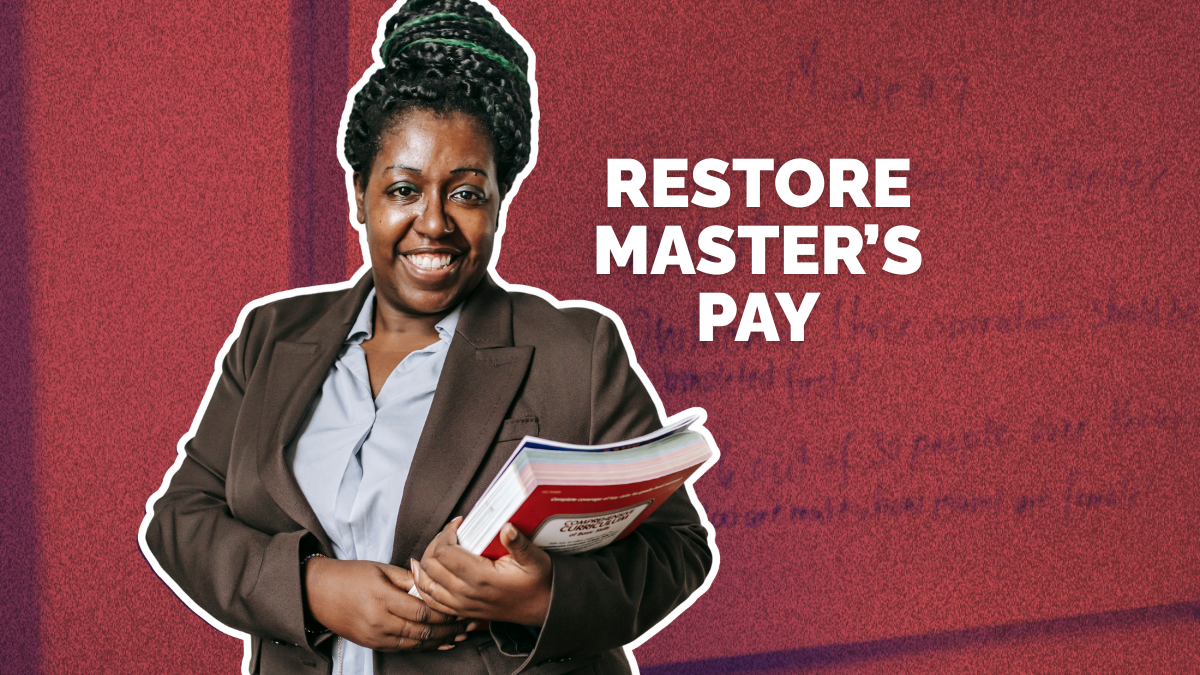
The latest state budget included an 8% average pay raise for teachers; however, veteran teachers received a much lower pay raise. Additionally, North Carolina eliminated the benefit of master’s pay for teachers.
North Carolina used to provide teachers with a master’s degree a 10% annual pay raise but cancelled the benefit in 2013, becoming the first state to do so. Since then, a number of bipartisan bills have been brought forward trying to reinstate master’s degree pay, with even local governments like Wake and Durham schools using excess funds to provide master’s degree pay for their teachers.
Those against master’s pay, such as Senate leader Phil Berger, argue that master’s pay is a waste of money. However, educators and education advocates like Joanna Loftis, president of the American Federation of Professional Educators of North Carolina, say this is a benefit for students and teachers alike.
“They (students) benefit from having experienced teachers who know them and understand what they need,” Loftis said. “Master’s pay won’t fix everything, and a degree alone doesn’t make someone a great teacher. “But encouraging teachers to keep learning —and paying them for that additional expertise — makes sense for our teachers and our students.”
Loftis also argued that master’s pay could encourage these teachers to stay with schools longer as well as attract new teachers with master’s degrees to North Carolina classrooms. Support for reinstating master’s pay goes all the way up to the Governor’s office, as Democratic Governor Josh Stein asked lawmakers for $10 million of annual funds for that very purpose.
But Reives already has an idea of where some of the money for funding master’s pay, teacher raises, and other public school needs could come from: the state’s Opportunity Scholarships program. The Opportunity Scholarships program is a tax-funded program that allows families to get a voucher from the state to pay for a child’s attendance at eligible private schools.
However, recently lawmakers removed the income cap for the program and put over half a billion dollars into the program for the 2026-27 fiscal year. Once a program aimed at helping those in need, it now serves many families with children who were never in public school to begin with.
“Everybody has a lot of opinions about the opportunity scholarship program and the voucher program,” Reives said. “I will tell you this: I think one thing that Republicans and Democrats agree on is that it is ridiculous that somebody who’s making millions of dollars gets a coupon from the state when we can’t afford to pay for public education.”
Critics of the program say those dollars could go into building up public schools, which is still the number one avenue of education choice in North Carolina. Reives wants to take a closer look at the program and see what spending can be shifted so all students in North Carolina are getting the best education this great state can offer.
The newly elected lawmakers will be sworn in January 2027 before starting the first session of the year with a new makeup of the General Assembly.