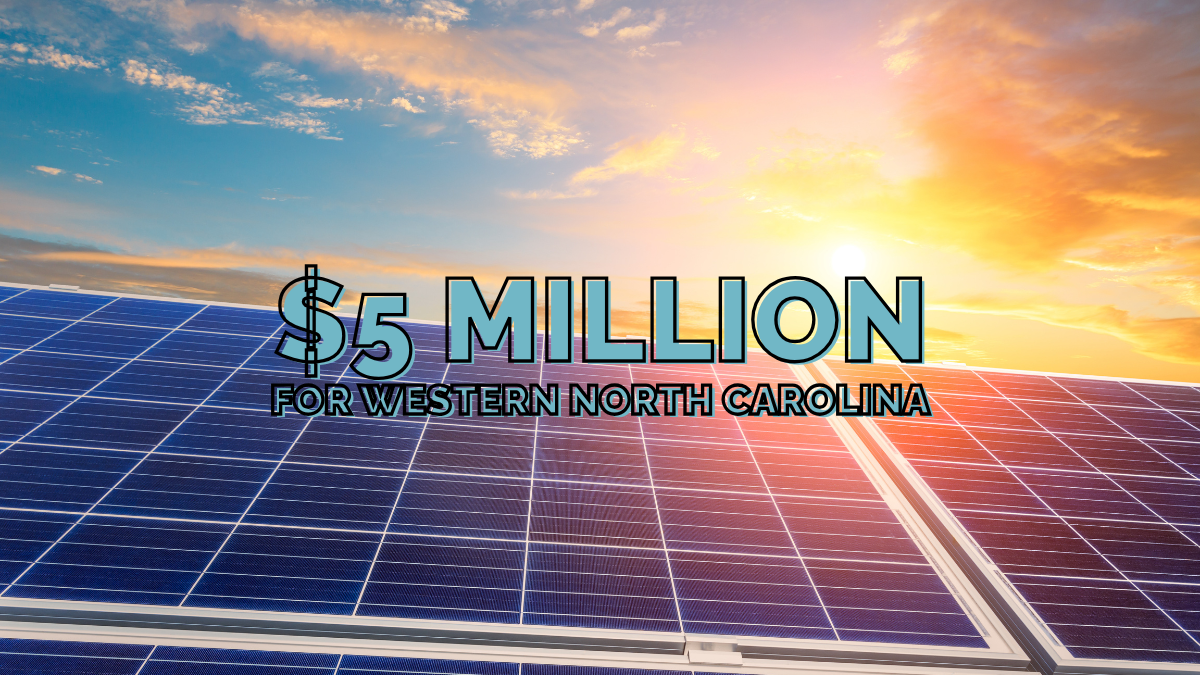
After Hurricane Helene knocked out power and internet service across much of western North Carolina in 2024, it became clear that disaster preparedness must include diversified energy sources. Now, thanks to a $5 million grant from the North Carolina Department of Environmental Quality, western North Carolina is embarking on an ambitious new initiative to ensure that critical facilities can keep operating even when the main electric grid fails.
The initiative, spearheaded by the Land of Sky Regional Council, NC Sustainable Energy Association (NCSEA), Footprint Project, and a network of regional partners, aims to build up to 24 permanent microgrid systems in six counties (Buncombe, Madison, Rutherford, Yancey, Mitchell, and Avery) as well as two mobile systems that can be deployed across the state.
“Generating power at giant plants far away and transmitting it across long lines is inefficient and extremely vulnerable,” economic and community development specialist Ian Baillie said. “If we generate power inside communities and keep the distribution inside those communities, outages affect smaller areas and are easier to fix.”
The microgrids will combine solar panels with battery storage systems that can operate independently of the main grid during outages. Unlike traditional backup generators, the systems will run on renewable energy and require less fuel logistics during emergencies. And each system will be installed at an existing community hub that helped with Hurricane Helene disaster response; places like food banks, churches, and fire stations.
“These are places that already stepped up during Helene,” Baillie said. “We’re asking: what did you do for your community, and would resilient power have helped you do more?”
In addition to the permanent microgrid systems, the plan calls for two mobile resilience hubs, nicknamed “Beehives,” to be built and stationed at opposite ends of the state. The hubs will consist of a shipping container command center with solar panels, battery storage, and communications equipment, as well as three trucks that can provide power through solar plus battery storage, water generation and filtration, and cooling systems.
“It’s really, really difficult to predict which communities will be impacted most. You can invest in permanent microgrids, but if you’re talking about a natural disaster, you might have a community that’s completely untouched, but then five minutes down the road, a community that’s completely devastated,” NCSEA Executive Director Matt Abele said.
If successful, the model could expand across North Carolina and beyond.
“We truly believe in the technology,” Baillie said. “The goal is to prove it works so this can scale across our state and every other state.”