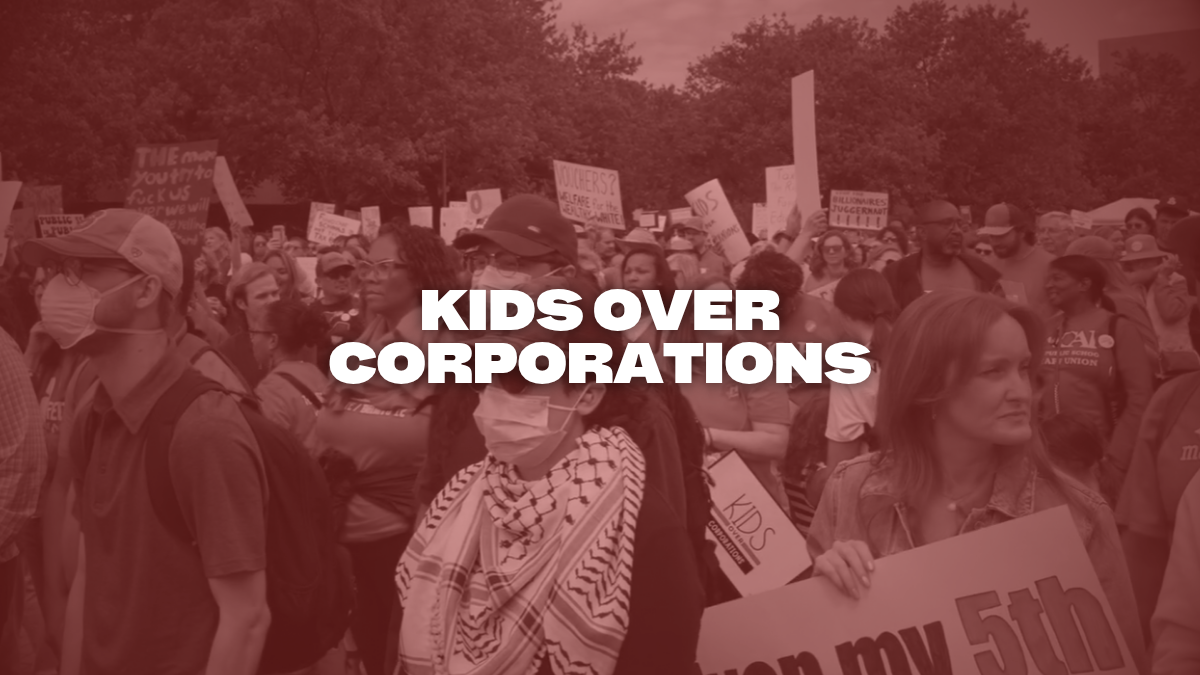
May 1st was International Workers’ Day. and educators, students, parents, and advocates gathered at Halifax Mall to march and rally for education justice. The ‘Kids Over Corporations’ march and rally, hosted by the North Carolina Association of Educators, or NCAE, centered around five demands: investing 20,000 per student in North Carolina’s public schools by 2030, ending corporate tax cuts, eliminating private school vouchers, fair maps. and restoring checks and balances, and the right to organize and bargain collectively.
In this moment, advocating for education justice is more important than ever. In April, Leandro, the landmark education funding case that guaranteed every child access to a sound, basic education, was dismissed by the Republican majority on the North Carolina Supreme Court. On top of the ruling, our state is still the only state in the country without a comprehensive budget, leaving millions of dollars for public school investments on the table.
“We are with those most vulnerable students that really need us more than anything, and we’re determined to still be here for them, but we are hoping for support along the way,” said Ellen Jerome, a Wake County special education preschool teacher.
North Carolina currently ranks 46th in the nation for average teacher’s pay and 50th in funding effort, according to the Education Law Center’s 2025 Making the Grade report.
“We just want to be able to pay for our house, pay for food, and not have a second job,” said Kandice Nangle, a Wake County emotional behavior support classroom teacher.
Thousands of educators and advocates attended the march – sending a message to the legislature that education is definitely a top issue in our state. The legislature must take action to improve outcomes for students and teachers in our public school system.
Going forward, we must continue the work of advocating for education justice by attending local public school board meetings, joining advocacy groups like NCAE and Public Schools First, and spreading the word about the impact of the lack of public school funding in our state.