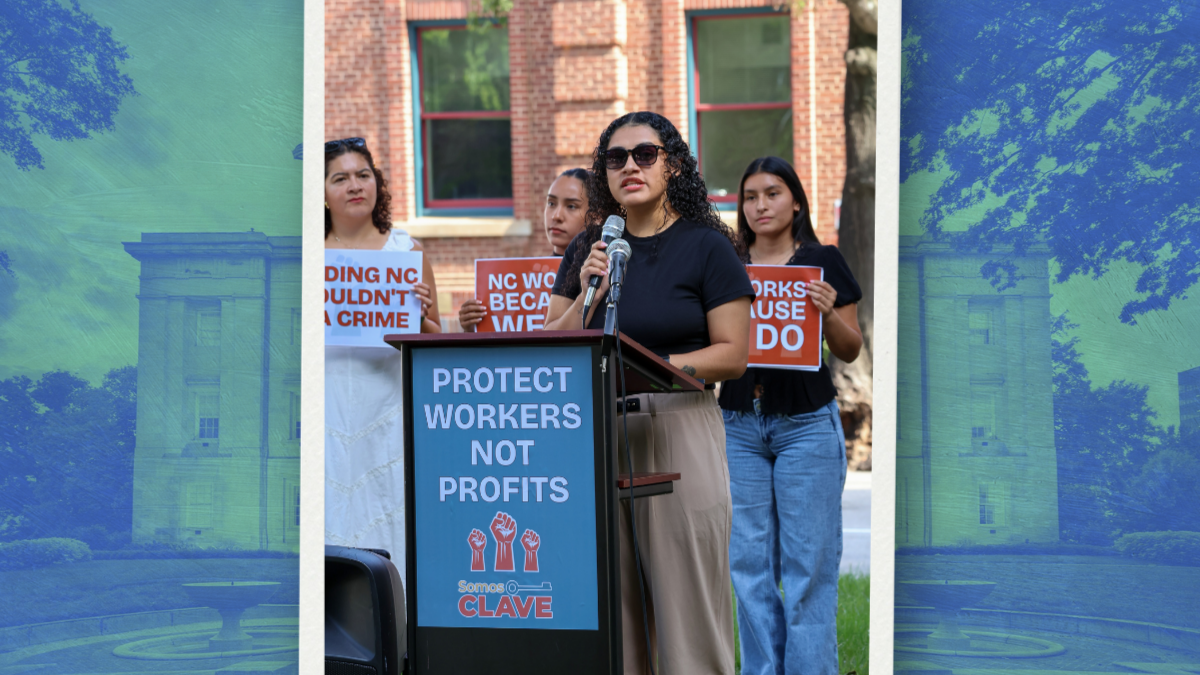
Farmworkers and community advocates gathered Thursday outside the North Carolina State Capitol to call attention to the dangerous working and living conditions farmworkers face across the state, including extreme heat, inadequate housing, low wages, and a lack of comprehensive heat protections. The event centered the voices and experiences of workers who play a vital role in North Carolina’s economy.
Esmeralda Juárez, who has worked with NC FIELD for more than three years, shared her experience working in the fields as a minor in eastern North Carolina. More than a decade ago, Human Rights Watch photographed her working in a tobacco field when she was 16 years old. “For the first time, I’m here to say that little girl was me,” Esmeralda said. “Even at that age, I knew something wasn’t right. My head hurt, my stomach hurt, and I was so nauseous that I wanted to throw up.”
Esmeralda recalled working long hours in tobacco fields while struggling to breathe and experiencing blurred vision. She said she worked because her family depended on her income.
“When the money you earn helps make sure your family has what they need, staying home isn’t an easy option. It’s survival,” she said. Esmeralda called for stronger protections for workers, especially children and those working in extreme temperatures. “Water alone is not enough,” she said. “Workers need shade. We need paid breaks. We need training we can understand, time to adjust to extreme heat, a wage that allows us to afford the fruits we harvest and the tools we need to stay safe.”
Andressia Ramirez, Advocacy and Civic Engagement Manager at Casa Azul of Wilson, shared a recent experience while visiting a farmworker camp in Wilson. On a day when temperatures reached 95 degrees, Ramirez found a young worker sitting alone on a bucket under a tree because he had a fever and it was the coolest place he could find.
“Not a bed. Not his home. A bucket under a tree,” Ramirez said. “Because in North Carolina, farmworker housing still isn’t required to have air conditioning.” Ramirez also described visiting another camp where workers only had access to outhouses.
“How much dignity are we willing to continue taking away from people before we decide enough is enough?” she asked.
Ramirez emphasized that protecting farmworkers and supporting farmers do not have to be opposing goals. “We can support our farmers without sacrificing the people who work their fields,” she said. “Because these workers leave their families for months so other families can have food on their tables.”
Both speakers called on state and federal lawmakers to strengthen worker protections, improve farmworker housing conditions, ensure fair wages, and establish meaningful safeguards against extreme heat.
“The little girl in that photograph was doing what she thought she had to do to help her family survive,” Esmeralda said. “She deserved better then. The children working in North Carolina today deserve better now.”
Ramirez echoed that call for dignity and accountability.
“It is our responsibility to make sure the next farmworker who has a fever has somewhere better to recover than a bucket under a tree,” she said. “Because no one who feeds this country should have to struggle so hard just to be treated like a human being.”