The story was originally published on Working Class Stories.
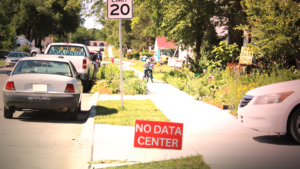
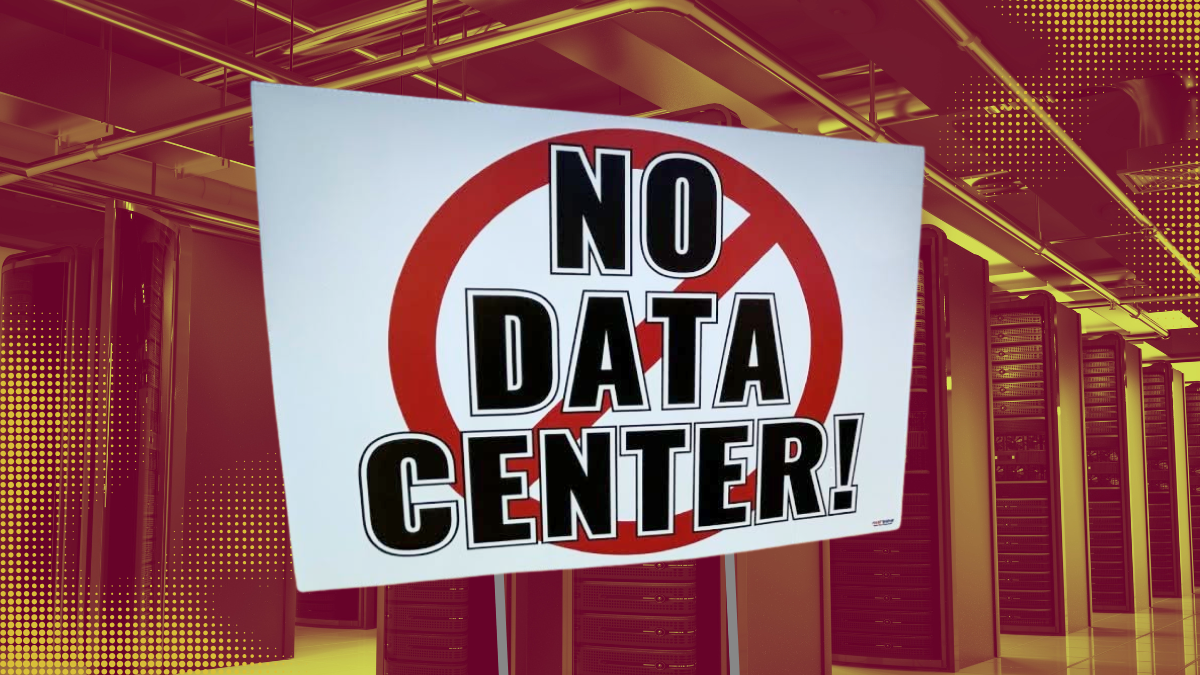
Working-class people in small towns across America are fighting the construction of data centers. I traveled to Rural Hall, NC, to find out why so many people are showing up over this issue.
By: Gwen Frisbie-Fulton
Carol tells me she drives like a turtle, but she’s whipping around the turns of rural Forsyth County roads nonetheless. She’s been driving them all her life.
As she drives, she tells me what I’m seeing. This is the house where her cousin lives; this is where so-and-so had a farm. She points out the library and tells me about the time she socked a bully there and got banned for a week as a kid.
Six generations of Carol Newsome’s family land is sprinkled between the roads and neighborhoods. She points out the old cabins, the acreage, and tells me the history. Her great-great-granddad’s house is the oldest still-standing house in town.
Rural Hall is small, but growing. There are about 3,000 residents now, but Carol remembers it from the 70s, before it became incorporated.
Carol’s dogs bark wildly as we pull into her driveway. She points to a stand of trees across the road, nestled up to the railroad tracks. Once she was offered money for that stretch of land to build an truck access for an industrial area. “But I guess that the trees and the pileated woodpecker are just more important to me than money,” she laughs.
The trees, pinned between a pallet company and the tracks, remain lush and green.
But it’s not Carol’s property that she’s brought me here to see. It’s the land just beyond those trees. That’s the land that is now being sold: the old Wall family farm.
And that’s why I’m here in the late June heat, in a small town in rural North Carolina: 129 acres of controversy.
Earlier this spring, Nancy Jones got a notice in the mail from Forsyth County about the Wall farm, which sits just across the road from her property. Everyone within 500 feet of the property received notices the same day.
The notice was about a zoning change that would turn the farmland into industrial property. “There was a map on the back in a square that was yellow, and that was the proposed property for rezoning,” says Nancy. “Then all the way around that was a green area, and it showed everybody’s homes. And there mine was.”
Nancy moved to Rural Hall from northern Virginia a decade ago to find a quieter, more peaceful place. She lives here in a modest home with her daughter and grandchild on a few acres. “We’ve got chickens, we’ve got gardens, my daughter is a beekeeper. We love our little plot of land.”
It’s a good place to live; a slower pace than where she came from. Now Nancy says it feels like she’s being chased.
A second letter came, this time from a company called Montrose, saying it wanted to build a hyperscale data center on the farm. The neighbors dug around and found that Project Iron Spur would include three buildings totaling 1.3 million square feet and standing 84 feet tall. In other words, you’d be able to see the data center, with racks of air conditioners stacked on top, whirring to keep it cool, over the tree line. “It would be the only thing higher than steeples,” says Carol.
While not part of the town proper, Wall Farm is surrounded on nearly all sides by Rural Hall. Churches, a cemetery, and several small neighborhoods all back onto the farm, which is 130 acres of gently rolling pasture with a creek running through its middle.
Because it’s rural land and the town is diffuse, it’s hard to describe how this land is smack in the middle of Rural Hall until you are there driving these roads with Carol. As you step out the doors of Abe’s Market, or put flowers on a grave at Nazareth Lutheran, or run the flag up the pole in front of town hall, you are looking right at Wall Farm.
“To build a data center here makes no sense. It’s like they don’t care at all about us,” says Nancy.
So when she got that letter, Nancy yelled downstairs, where her daughter Jean was working. “I yelled so loud she probably thought someone had died.”
Jean came up and looked at the letter. Like her mom, she had left northern Virginia and later Colorado because everywhere she lived, she kept getting hemmed in. “What bad luck is this?” Jean remembers thinking as she stared at the map.
“I told my mom: we can’t allow this to happen,” says Jean. The family didn’t want to—and couldn’t afford to—keep moving.
Jean thought maybe if they told the neighbors how bad these data centers are, they would convince them to oppose it. “I was getting ready to make flyers and go post them on people’s doors, but then, that same night, somebody came to our door and handed us a flyer.”
That was the good news of the day: They weren’t going to have to convince anyone this was a bad idea for Rural Hall. Everyone already knew.
“It’s hard to fight something when they won’t tell you what it is,” says Randy Adams.
Randy’s wife first told him about the data center—she had seen Carol post about it on Facebook. Carol runs a Facebook page called the Independent Hall Monitor, where she religiously posts about developments in local government. Like many small, rural places in America, the Rural Hall doesn’t have local journalists or a local paper. So, it was Carol who was watching a Council Meeting and caught the town manager’s brief mention of a “rezoning request” in the very last minutes before they adjourned.
While Randy had lived here a long time, he had never had the time to pay much attention to local politics. He’d spent his career as a truck driver, the last 21 years at UPS in neighboring Greensboro. “It was a 45-minute drive to get there, 45 minutes to get back, and no days were less than 10 hours. I couldn’t do anything but work at UPS, you know, take a bath, swallow my food, sleep six hours, and then it was time to go back to work.” He certainly never had the time to watch hours of town council meetings, so Carol’s posts had become a go-to source for the Adams and many of their neighbors.
But for all those years he couldn’t be involved in his community, Randy knew he was going to jump in now. “I had seen some stuff about data centers, but didn’t really lock in. I thought, well, that’s bad,” he said. “When I heard it was here, I thought, oh no, we don’t, we don’t want this at all.”
For Randy, it was the gall of it all. He’s spent his whole life living in this little corner of North Carolina, raising his family, working hard, and being a good neighbor. To him, the data center was all about outsiders who didn’t understand—or care about—their little slice of heaven or their lives.
“To have somebody in another part of the country see this land,” he says, “and then hire somebody to put in a permit for something that we don’t even want without any discussion, like they’re going to ram it down your throat, and they try to be so slick, it’s like a Kafka-esque story.”
Randy didn’t know the mayor of Rural Hall personally, but knew he lived on the road behind him. He figured that the mayor, Terry Bennett, main job was to hear from constituents and protect the town. So he looked up his number and gave him a call.
“I called him up to see what he knew about it,” explains Randy. “And he starts going… this thing is not going to bother anybody. I don’t know why you’re upset. What’s the problem here?” Randy realized the mayor knew very little about the project.
“I said [to the mayor] you were elected to protect us. All these fireworks and parades and all that stuff is great, but that’s not what you were elected for. You were elected to protect this town, and this is where you should step up.”
When the mayor and the council had little to offer except that “things will be fine,” Carol, Nancy, Jean, Randy, and a growing number of other residents were left to fill in the gaps. They began researching other data centers of the same size and scale to see how they had impacted local communities. Had they lived up to their promises of increased tax revenue? Did they create any local jobs? Or did they drive up electrical prices and use up local water? Nancy bought a decibel reader and visited other data centers of similar size to measure the noise.
What they found out didn’t look good for Rural Hall.
“If it hadn’t been for Carol and people like her, this would probably win with no problem,” says Randy. “We wouldn’t even know what was happening. They’d probably be tearing the ground up over there right now.”
Read the full story on Working Class Stories.
For a new story each week about working-class people, places, and organizing, subscribe here to Working Class Stories.
Gwen Frisbie-Fulton is a writer and organizer at Addition Project and is based out of Greensboro, North Carolina. She writes about working-class people, places, and organizing on the Substack Working Class Storytelling.