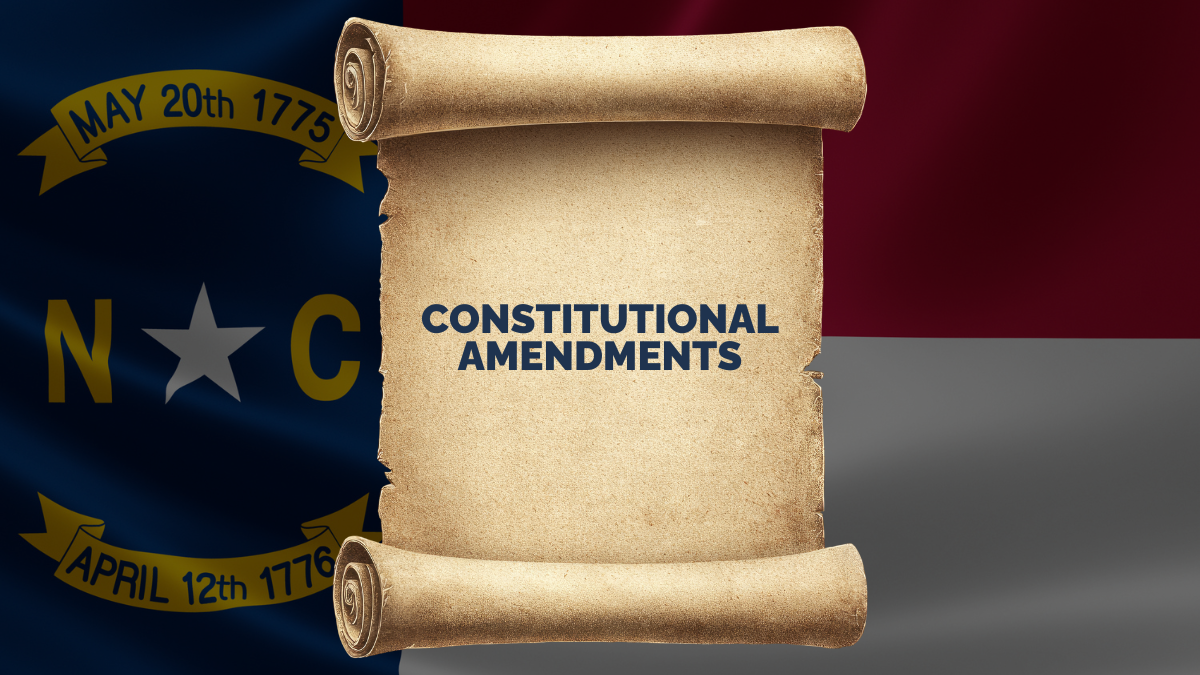
North Carolina lawmakers are back in Raleigh for the short session, and Republican leaders have quickly moved several constitutional amendments that could be on the ballot in the November midterm elections. While Democrats started the short session by filing bills to lower healthcare costs, raise the minimum wage, and increase government transparency, Republicans have refused to hear those bills and instead have rushed through several unnecessary constitutional amendments.
If all of the suggested amendments pass, it would result in the highest number of ballot amendments since 2018. Here’s a look at what’s being passed, what’s being said, and what these amendments will actually do.
Senate Bill 1080: Lower Taxes for All NC
Despite its name, Senate Bill 1080 will not significantly lower taxes for working families in North Carolina. Right now, people in North Carolina and across the country are being squeezed financially at the gas pump, grocery store, and hospitals. Republicans have stated the bill is a way to show voters they want them to pay less.
Senate Bill 1080 creates a cap on income taxes, making the maximum rate not exceed 3.5%. Currently, North Carolina’s income tax rate is 3.99%.
It’s a small change for the families of North Carolina that won’t make a dent in the financial troubles people are feeling due to Republican policies, but will amount to a significant tax break for the ultra-wealthy in the state. This bill has passed both chambers and will be in front of voters in November.
House Bill 1089: Constitutional Amendment Property Tax Levy Limit.
Similar to the Senate bill mentioned above, House Bill 1089 aims to put a cap on taxes, this time focusing on property taxes. Unlike the Senate’s bill, this legislation does not specify what the cap would be, only stating that lawmakers would have the ability to enact a cap of some rate at some point, which they already have the power to do. Regardless, a property tax cap would result in tax breaks for major corporations and the wealthiest few in the state.
In addition to tax breaks for the wealthy, this bill would result in local municipalities and the people they serve suffering from a decrease in county funds. Property taxes fund roughly 44% of county general budgets, which pays for public schools, emergency services, and parks. This comes at a time when county governments are already struggling due to state and federal cuts and the Republican infighting that resulted in lawmakers being more than 10 months late in establishing a state budget. This bill has also passed both chambers and will be in front of voters in the November election.
Senate Bill 1082: NC Right to Work Amendment
Senate Bill 1082 is described by Republican lawmakers as a way to make sure no one in the state is pressured into joining a union at their place of work. The concept makes sense, which is why it’s already state law. The head of North Carolina’s AFL-CIO, Braxton Winston II, called the legislation a waste of time and argued lawmakers should instead tackle issues that voters are actually facing.
“They are worrying about the impossible choice between keeping the lights on and putting food on the table,” Winston II said during public comment.
This bill has passed the Senate and is waiting to move through the House.
Senate Bill 1081: Right to Farm
This bill would enshrine “the right to farm” in the state’s constitution, but it will virtually change nothing.
Senator Lisa Barnes, who works in agriculture outside of her job as a legislator, spoke about how there’s currently already “strong statutory protections in place,” but still pushed for it to be added into the constitution.
This comes at a time when what’s hurting those in the agricultural sector is soaring fuel costs and inflated prices from President Donald Trump’s harmful tariffs. If state Republican lawmakers who put this amendment forward cared about agriculture in the state, they would address and tackle those issues that are most pressing to farmers, instead of having them vote on the rights they already have.
The bill hasn’t been voted on either chamber’s floor, but is currently moving through Senate committees.
HB 443: Constitutional Amendment: Council of State Vacancies.
This bill limits the Governor’s power to appoint individuals to the Council of State when a seat becomes vacant. The Council of State is made up of the 10 officials in the state’s executive branch elected by voters: the governor, lieutenant governor, attorney general, auditor, treasurer, secretary of state, superintendent of public instruction, and the commissioners of insurance, labor, and agriculture.
Currently, Governor Josh Stein holds the power to fill any vacancy at his discretion. This amendment would make it so that Gov. Stein is limited in picking a replacement by requiring him to choose from a list of individuals picked from the political party of the existing member. This is yet another bill put forward by state Republicans aimed at siphoning power away from Democratic Governor Josh Stein and other incoming Democrats who won Council of State seats in 2024.
The bill passed in the House and is waiting to move through Senate committees.
House Bill 144: Elect SBE/Superintendent as SBE Chair.
Like the one above, this bill makes major changes to the makeup and operation of state government. Currently, the State Board of Education is made up of 13 members: the Lt. Governor, the State Treasurer, and 11 members representing North Carolina’s districts who are appointed by the Governor for eight-year terms.
This amendment would instead make the 11 non-council of state members run in an election and make the Superintendent of Public Instruction, currently Maurice “Mo” Green, the head of the board. The bill does not specify if the elections for those 11 seats would be partisan or not, or what map would be used to assign the 11 individuals. This bill is currently moving through House committees.
Critics have called many of the amendments performative measures from state Republicans ahead of the November elections. This army of amendments comes after a major primary election in March, where Democrats highly outnumbered Republicans at the polls and ousted several sitting Republicans, along with a few Democrats who often sided with them.
The people of North Carolina are in need right now due to harmful Republican actions at the state and federal levels. The people are calling on lawmakers to pass meaningful legislation, like a state budget to fund public schools, emergency responders, and state programs, which can be seen in Gov. Stein’s recently proposed budget.
Gov. Stein’s budget also includes targeted tax cuts that would focus on the families of North Carolina, making “meaningful tax relief while maintaining the resources needed to fund essential services,” according to a press release.
With Republicans in charge of both the House and Senate, they have the power to make real, meaningful changes at a time when the people they are meant to represent are struggling.
Instead, it seems they intend to move full speed ahead with smoke and mirror legislation to deceive voters and pass measures to benefit themselves.
As Winston III put it: “Our constitution is a sacred document, not a political tool.”