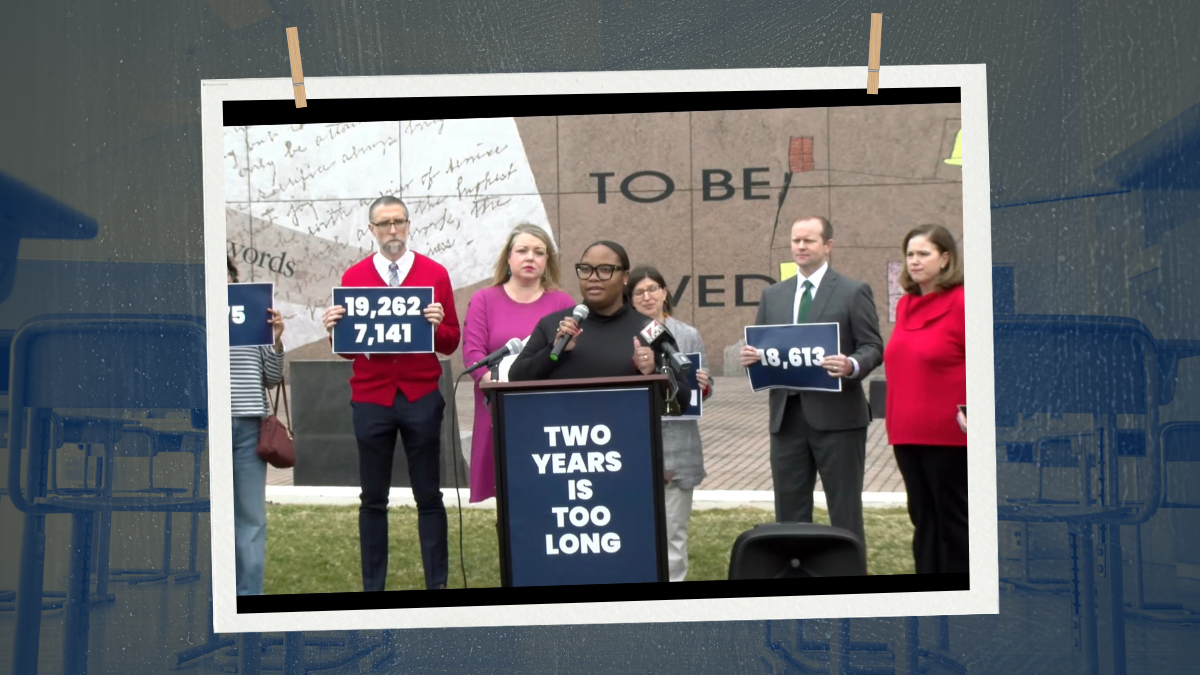
On Wednesday, education leaders, parents, and advocates from various groups stood outside of the North Carolina Department of Public Instruction to demand action on Leandro, a decades-long case that is the basis of education policy in the state.
The Leandro case was brought forth by families and students in underserved communities with the promise of the NC Supreme Court that all students deserve fully funded public schools. However, that promise has been broken with the Republican-led NC Supreme Court that we have now. For two years, the Court has stalled on making a decision on Leandro, leaving crucial public school funding in limbo, with education professionals fending for themselves and their students due to a lack of adequate funding.
“In the last two years alone in North Carolina, we have lost 19,262 teachers to other jobs; we have 7,000 teaching vacancies in the profession right now,” said Bryan Proffitt with NCAE, during the press conference.
With Leandro in limbo and North Carolina being the only state in the country without a budget, public education funding is in the spotlight. Over the past few months, advocates have been urging Senate President Phil Berger and House Speaker Destin Hall to act on passing a comprehensive budget and stop putting profit over people.
“Today we’re asking Senate President [Phil] Berger, Speaker [Destin] Hall, to end this corrupt tradeoff, to stop putting the donor class ahead of North Carolina’s children, and to fully fund Leandro,” said Kris Nordstrom with the North Carolina Justice Center.
The Education Law Center’s 2025 Making the Grade report gave North Carolina an F in public school funding efforts despite being the wealthiest state in the country.