‘I fear every day that somebody is going to say, You don’t have these services anymore,’ said Meredith Vaughn.
By: Rebekah Sager
This story was originally published on North Carolina Independent
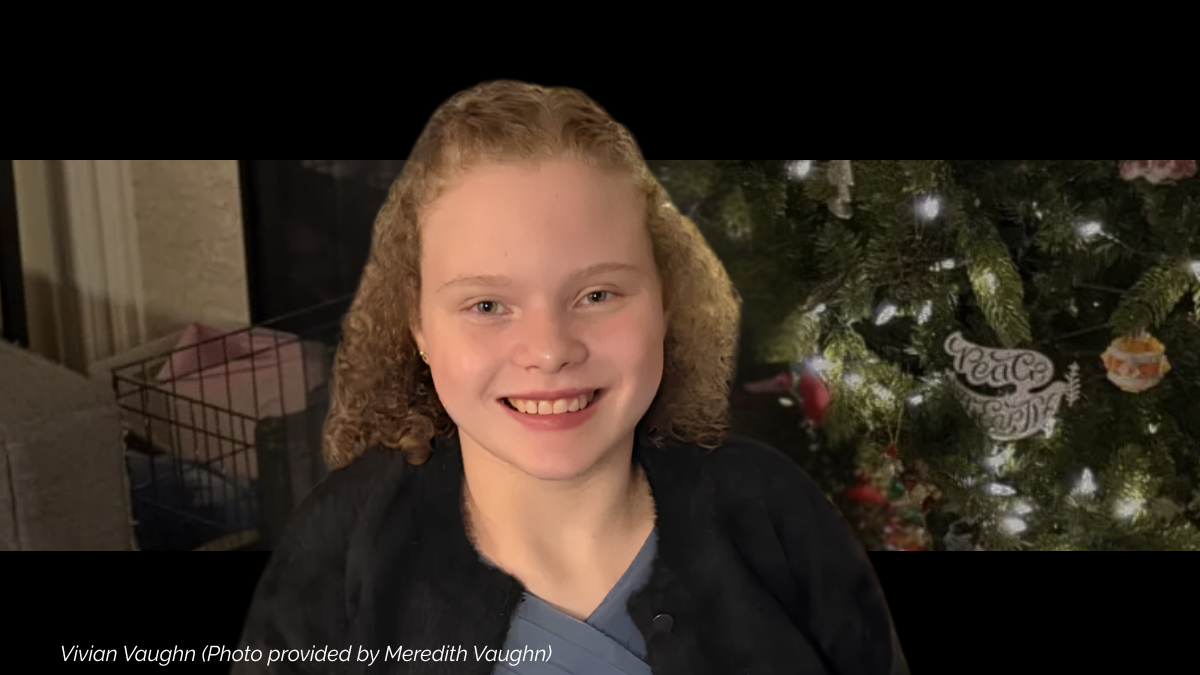
Meredith Vaughn’s daughter, Vivian, or “Vivi,” as her friends call her, is 12 years old. She is a voracious reader and loves the musicals “Wicked” and “Hamilton.”
Vaughn told the North Carolina Independent that because Vivian was born 12 weeks premature, she has several health issues, including cerebral palsy.
Vaughn, who works remotely for a pharmacy department, said that since the day Vivian was first diagnosed, she has remembered what a friend told her: that her daughter should not be defined by her illnesses.
“She is Vivian. She is amazing. She is funny. She has something to say about everything, sometimes it’s not nice, sometimes it’s profound. She’s like an old soul,” the Winston-Salem mom said. “She has gone through a lot. She’s had multiple surgeries, mainly due to her hydrocephalus [a buildup of cerebrospinal fluid in areas of the brain that increases pressure on it] because she’s had shunt malfunctions. In fact, she just had one last week, and we had emergency surgery last Monday. So she’s a gift to me, and I am proud of her.”
Vivian uses a wheelchair, requires both occupational and physical therapy, and has a caregiver who helps her around the house and to take her to and from doctor appointments. Vaughn said without the help of Medicaid, the family could never afford her care: “I fear every day that somebody is going to say, You don’t have these services anymore. I just fear that on so many levels.”
North Carolina’s Community Alternatives Program for Children (CAP/C) provides Vivian’s healthcare coverage. The state-run program is authorized under a provision of the Tax Equity and Fiscal Responsibility Act passed by Congress in 1982. The law authorizes states to waive standard Medicaid eligibility rules in order to cover children with disabilities regardless of their families’ income, enabling those children to receive care at home or in their communities rather than in hospitals or long-term care facilities.
Signed into law by President Trump in July 2025, the One Big Beautiful Bill Act established new administrative requirements and conditions for eligibility for Medicaid coverage, with proponents framing the new measures as anti-fraud and anti-abuse reforms.
The law institutes new work requirements for all able-bodied adults ages 19–64 that can be met by, among other options, working at least 80 hours per month or showing a monthly income equivalent to 80 hours at the federal minimum wage. Such requirements will probably not affect the Vaughns; however, the new law also requires states verify eligibility for some Medicaid recipients twice a year, versus the current requirement of once annually.
According to Disability Rights Education and Defense Fund, between 2.2 million and 6 million children nationwide are covered by Medicaid due to a disability or special healthcare needs.
Vaughn said the implication that she and other families with kids like Vivian are committing fraud makes her angry and is “absolutely ridiculous.”
“People are saying, Oh, you don’t need services, you’re the parent, you should be taking care of this. Well, there’s families out there that have to be home with their child. They don’t have a choice in the matter: They have to be home,” said Vaughn, who has two other daughters in addition to Vivian, Savannah, 15, and Braelyn, 8. “I can’t be there for everything, and my husband can’t be there for everything, because we have jobs, and if we didn’t have a care attendant, one of us would have to quit, so that means we’re down in income, and it just baffles me. It baffles me why they want to point at the families, at the children, at the adults with disabilities, that — why do they want to do that? It just is a narrative for them, a reason for them to do whatever they’re doing, whatever they want to cut, and it just is so harmful.”
Vaughn said one of the reasons she is an advocate with the children’s healthcare lobbying group Little Lobbyists is that it puts the kids at the center of the story.
“I get to tell my side all the time, but what is it that the child feels?” she said. “And I know not every child is able to express that, but Vivian can. She can share, and she can speak out and advocate, and she hears all the things and knows all the things. She’s not naive, and people think that I would be using my child, but no, I’m not, because this is her life and this is important to her.”
The North Carolina Independent is a project of American Independent Media, a 501(c)(4) organization whose mission is to use journalism to educate the public, giving them the information they need about local and federal issues. Read more at The North Carolina Independent.